
The rapid rise of artificial intelligence in classrooms is exposing deeper weaknesses in the education system rather than creating entirely new ones, according to educator Dr Samuel Joseph.
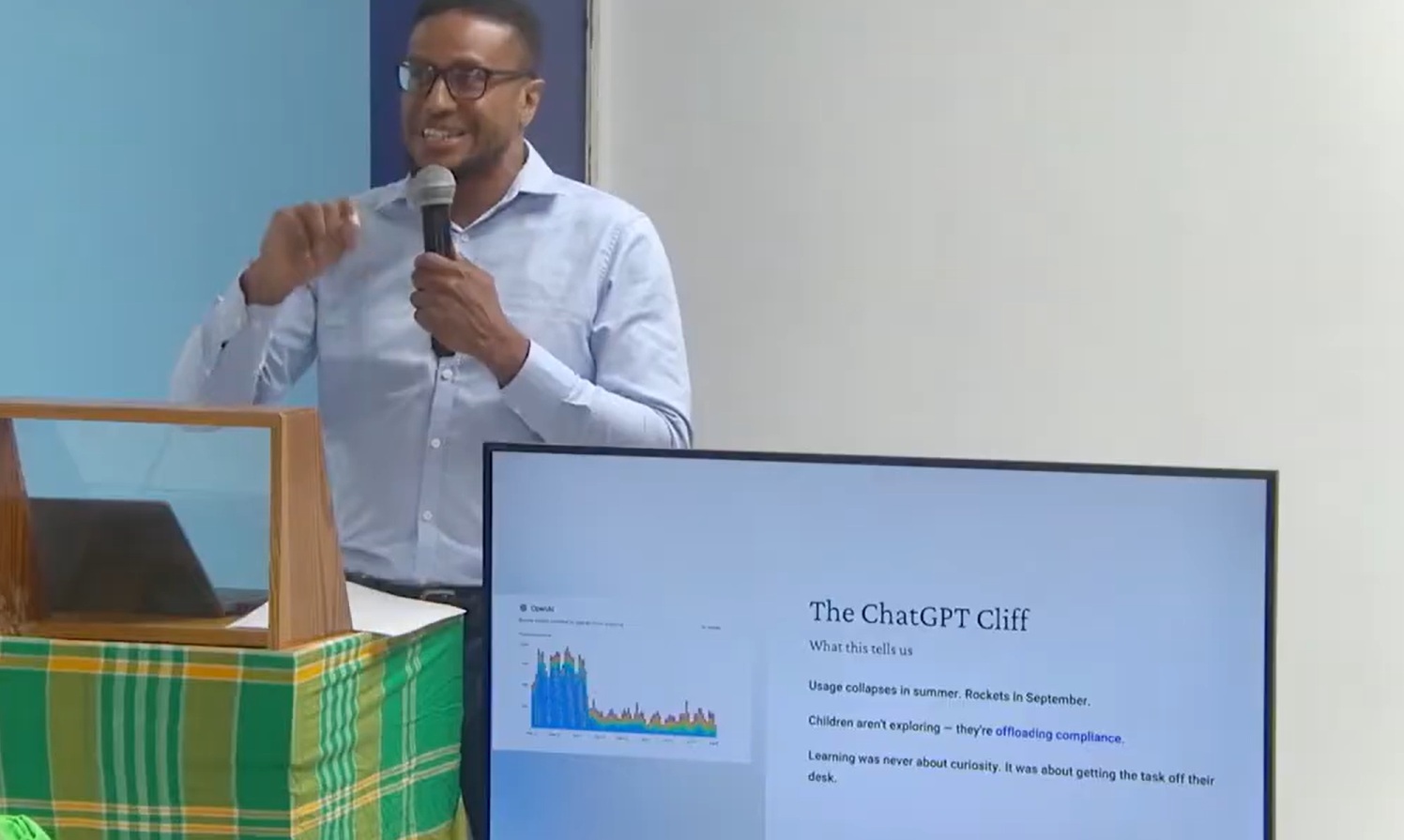
Speaking during the annual St Patrick’s Lecture at the Montserrat Public Library on Wednesday night, Joseph pointed to an unusual data trend involving ChatGPT usage that he believes reveals how students are interacting with new technology.
He explained that global usage patterns for the platform remain steady during the school year but drop sharply around June.
“Around June it collapses,” Joseph told the audience. “School is out.”
For Joseph, the pattern suggests that many students are not using artificial intelligence to explore ideas or deepen their understanding. Instead, they are primarily using it to complete assignments given by teachers.
“They are not using it to think,” he said. “They are using it to reproduce work.”
Joseph described the pattern as a form of intellectual outsourcing, where a task moves from a student’s desk to a remote server and then returns as a finished answer.
“It is getting a task from their desk onto a server in California to bring back the answer to their desk,” he said.
Once the school task disappears, the use of the technology drops sharply.
“That tells you the thinking stops when the school environment finishes,” he said.
The former minister of government argued that the trend reflects a deeper issue within education systems that prioritise procedures and memorisation over understanding and reasoning.
To illustrate his point, he described a classroom exercise involving fractions.
Students were asked to divide a sheet of paper into six equal pieces and label each piece as one sixth. When asked to combine fractions using the pieces, many quickly arrived at correct answers simply by counting the physical sections in front of them.
However, some of the highest-performing students struggled because they tried to recall formal procedures involving denominators rather than engaging with the visual problem directly.
“They were trying to remember the procedure they had been taught,” Dr. Joseph explained.
The exercise demonstrated how rigid processes can sometimes interfere with understanding.
“We don’t teach mathematics,” he said. “We teach procedures for children to follow.”
Joseph said this approach can lead students to believe they are incapable in certain subjects, particularly mathematics, even when they demonstrate strong reasoning ability in other contexts.
He also warned that the arrival of artificial intelligence is making the weaknesses of this system more visible.
“We are teaching our children to be computers at the exact moment in history when computers are better than them,” he said.
Rather than banning technology entirely, Joseph argued that students must first develop the intellectual foundation needed to guide and evaluate it.
Also read St Patrick’s Lecture Urges Montserrat to Raise Thinkers, Not Followers – Discover Montserrat
Reading comprehension, writing ability and reasoning skills remain essential.
“If you can read and reason, you can direct the AI instead of the AI directing you,” he said.
Without those skills, however, the technology risks becoming a substitute for thinking.
“Getting an answer is not a skill,” Joseph reminded the audience. “Anybody can do it.”
What matters, he said, is the ability to ask meaningful questions and evaluate the answers that follow.
In the decades ahead, Joseph suggested, societies that prioritise thinking and curiosity will be far better positioned to adapt to rapid technological change.
Discover more from Discover Montserrat
Subscribe to get the latest posts sent to your email.

