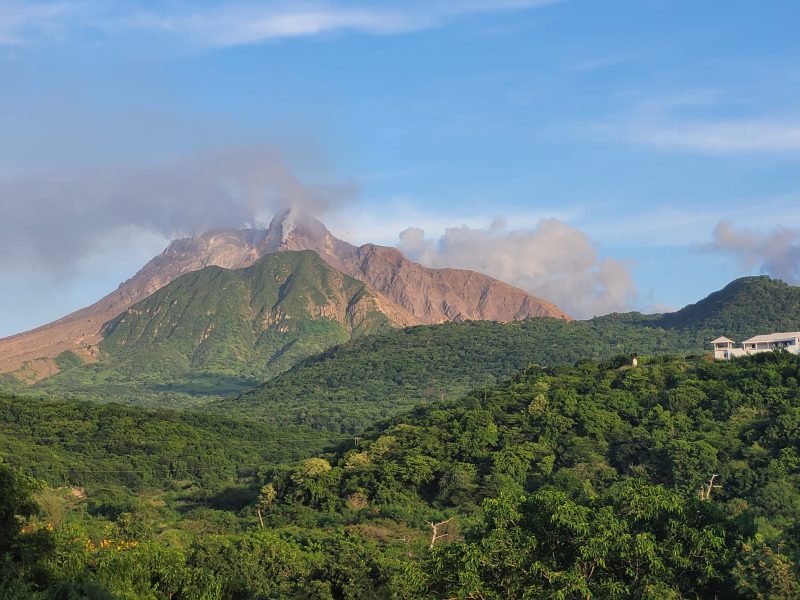

The Soufrière Hills Volcano continues to show low and declining levels of unrest, with no indication of a resumption of eruptive activity, according to the latest preliminary statement from the Montserrat Volcano Observatory (MVO).
The statement, released on November 6 as Preliminary Statement SAC 31, reports that the volcano continues to exhibit modest ground deformation, degassing and seismic activity. However, the overall assessment is that unrest has continued to decrease since the end of the 1995-2010 eruptive period.
The MVO noted that higher rates of shallow volcano-tectonic earthquakes, first observed in 2019, have continued. However, low-frequency seismic activity has ceased over the past 12 months, while ground inflation has continued to slow.
Measurements of sulphur dioxide (SO₂) emissions remain slightly below the long-term average, although the lava dome remains hot.
According to the observatory, there is currently no clear indication of magma movement within the volcanic edifice. Nevertheless, some deep magmatic processes remain active, although these are also slowing.
The MVO said it would expect a detectable increase in unrest before the start of any new eruptive period, providing the observatory with an opportunity to identify warning signals through its continuous monitoring programme.
Despite the declining activity, the observatory cautioned that the volcano continues to present residual hazards, particularly within Zone V, because of the presence of the large, hot lava dome.
These hazards include explosions and pyroclastic flows in areas closer to the volcanic vent. However, the likelihood of such events occurring within the next year remains low, and they would likely be preceded by signals detectable by the observatory.
Lahars, or volcanic mudflows, triggered by heavy rainfall also remain a hazard.
The MVO emphasised that continuous monitoring remains essential, regardless of how quiet the volcano becomes.
Montserrat’s Soufrière Hills Volcano began its major eruptive phase in July 1995, transforming the island’s landscape and resulting in the destruction of Plymouth, the former capital, and the evacuation and relocation of thousands of residents. The eruptive period officially ended in 2010.
While the latest assessment provides further reassurance that volcanic unrest is declining, the observatory’s warning is a reminder that the volcano remains active and that residual hazards must continue to be taken seriously.
Listen to Volcano Vibes for the full conversation on the report. https://montserratradioecho.wordpress.com/2026/11/06/friday-november-6-2026-volcano-vibes-with-host-keyola-greene/
Discover more from Discover Montserrat
Subscribe to get the latest posts sent to your email.