
Meteorologist Dale Destin of the Antigua and Barbuda Meteorological Service has issued an early outlook for the 2026 Atlantic hurricane season, indicating that activity is likely to be above normal this year.
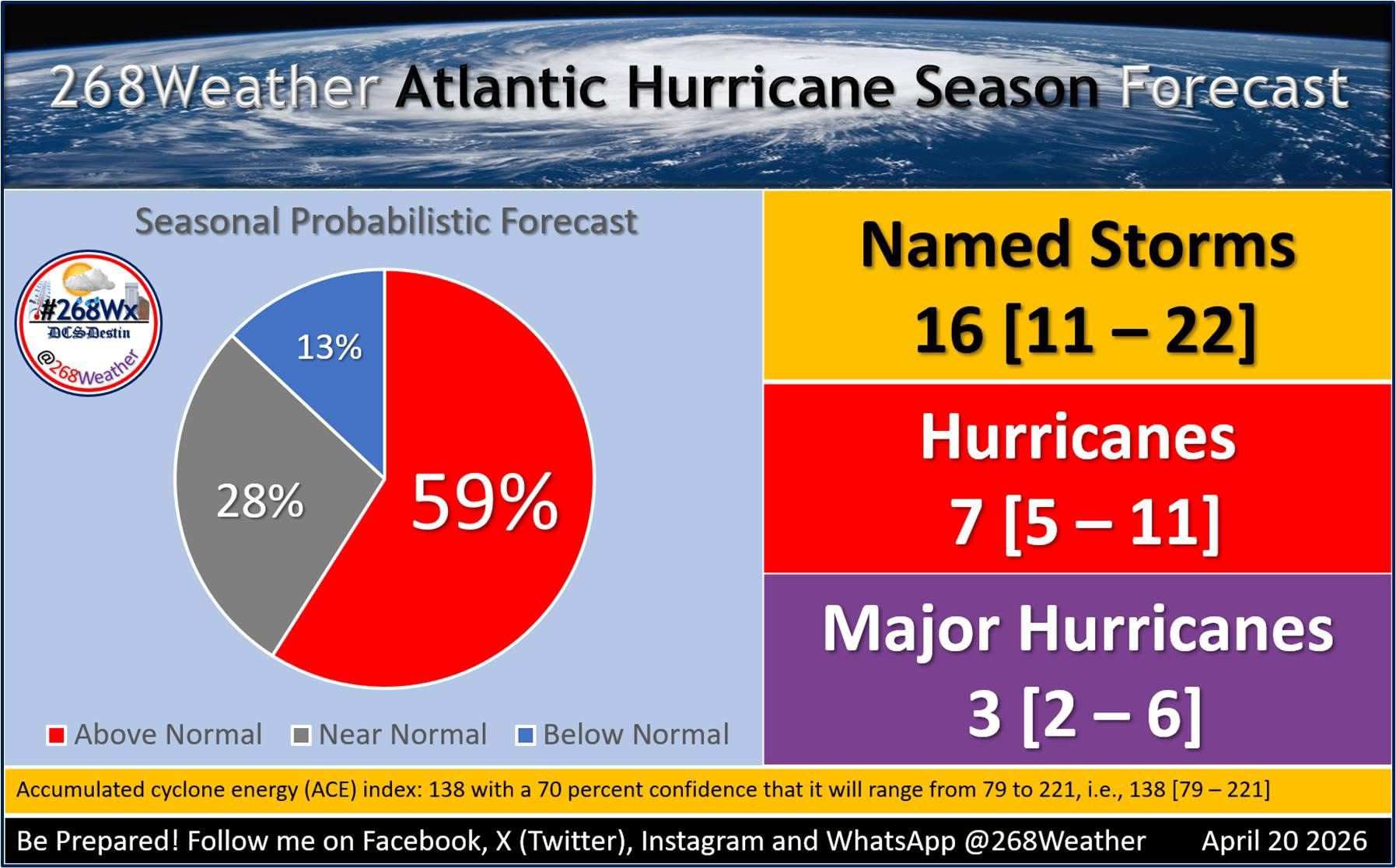
Destin’s forecast projects 16 named storms, including seven hurricanes and three major hurricanes. Major hurricanes are classified as Category 3 or higher on the Saffir-Simpson hurricane wind scale, with sustained winds of at least 111 miles per hour.
The outlook places the 2026 season slightly above the long-term average of 14 named storms, seven hurricanes and three major hurricanes.
The forecast also includes an Accumulated Cyclone Energy (ACE) index of 138, above the historical average of 123. ACE is a measure used to estimate the overall activity and energy of a hurricane season.
According to the outlook, there is a 59 per cent probability of an above-normal season, compared with a 28 per cent chance of near-normal activity and a 14 per cent chance of a below-normal season.
Destin noted that warmer-than-average sea surface temperatures in the tropical Atlantic are a key driver of the forecast. Warmer waters tend to fuel storm development, increase intensity and support higher overall activity.
However, this influence may be offset by the possible development of a moderate to strong El Niño event in the Pacific. El Niño conditions typically increase wind shear over the Atlantic, which can disrupt storm formation and reduce hurricane activity.
This combination of competing factors introduces uncertainty into the forecast, particularly at this early stage of the year. Forecasters also point to the “spring predictability barrier”, a period when climate models have lower accuracy in determining whether El Niño or La Niña conditions will develop.
As a result, the season could fall within a wide range, with estimates suggesting between 11 and 22 named storms, five to 11 hurricanes, and two to six major hurricanes.
The peak of the Atlantic hurricane season is expected, as usual, between August and October, when the majority of storm activity typically occurs.
Meanwhile, forecasters at Colorado State University have issued a separate outlook predicting a near-average to slightly below-average season, with 13 named storms, six hurricanes and two major hurricanes.
Despite the differences between forecasts, meteorologists stress that overall storm numbers do not determine local impact.
Experts emphasise that it only takes one storm to make a season dangerous, regardless of how active or quiet it may appear on paper.
Updates to the forecast are expected in the coming weeks as conditions in the Atlantic and Pacific become clearer.
Discover more from Discover Montserrat
Subscribe to get the latest posts sent to your email.