


LONDON, UK – Strengthening the relationship between Montserrat and its overseas community, mobilising professional skills and investment, improving healthcare support and creating new opportunities for trade and cultural exchange were among the key issues explored at the second Montserrat Diaspora Conference in London on 22 November.
Held under the theme “One Montserrat, Building Connections and Shaping the Future”, the conference brought together the Premier, government officials, diaspora organisations, community leaders, professionals and friends of Montserrat for a day of presentations and discussions on the island’s development priorities and the role of its overseas community.
Hosted by the Montserrat Government UK Office, the conference provided an opportunity for government departments and community organisations to share their work and identify practical ways in which the diaspora could contribute.
Opening the conference, Kei-Retta Farrell the UK’s Montserrat representative encouraged participants to leave with at least one commitment they could take forward, whether by offering a professional skill, supporting a project or making an introduction that could benefit the island.
The discussions reinforced a central message: the diaspora is not simply an overseas community maintaining its connection with home, but an important partner in Montserrat’s future development.
A 25-year Vision for Montserrat
One of the major presentations focused on the development of Montserrat’s new Sustainable Development Strategy (SDS) and National Development Plan (NDP) 2051.
Dionne Semple-Peters, Director of Policy and Planning in the Cabinet Secretariat, explained that the new framework represents the fourth development planning cycle since the volcanic eruption and introduces a longer-term approach to national development.
The Sustainable Development Strategy will establish a 25-year vision, supported by five medium-term National Development Plans. The first is expected to cover 2027 to 2032, aligning with the Government’s next budget cycle.
Semple-Peters said many of the priorities identified in the previous development strategy remain relevant, particularly human development, environmental protection, disaster preparedness, governance and the need to establish a viable population.
The new strategy identifies six national outcome areas:
1. Reliable access, connectivity and strategic infrastructure.
2. Economic transformation and private sector development.
3. Population renewal, human development and quality of life.
4. Sustainable land, environment and community systems.
5. Integrated governance and state execution capacity.
6. Building internal resilience and capacity.
She highlighted several areas where the diaspora could make a meaningful contribution, including sharing professional expertise, establishing business connections, supporting local producers to access external markets and helping to create opportunities for investment.
The draft strategy has undergone an initial consultation and technical review. Public consultation is expected to take place during January 2027, with the Government encouraging Montserratians at home and abroad to participate.
An intervention from the Ministry of Finance emphasised the importance of diaspora involvement, noting that the strategy would guide how limited public resources are allocated and help determine the island’s development direction beyond individual political administrations.
Premier Reuben T. Meade stressed that the plan would be subject to annual monitoring and review, allowing progress to be assessed and explanations provided where targets are not achieved.
Made in Montserrat seeks access to overseas markets
Economic development and the expansion of opportunities for local businesses featured prominently in the trade, investment and enterprise discussions.
Jerson Badal, Director of Business, Trade and Investment, outlined two major initiatives aimed at strengthening the private sector: the Made in Montserrat initiative and the Montserrat Business Progressive Fund.
The Made in Montserrat initiative seeks to transform the former PRIME marketplace from a once-a-year event into a sustainable platform for local products and businesses.
Badal explained that the initiative has already secured shelf space for Montserratian products at Victor’s Supermarket. Approximately 56 per cent of the initial stock was sold within the first month, demonstrating demand for locally produced goods.
The next phase will focus on improving packaging and labelling to meet OECS and CARICOM standards and prepare businesses for entry into external markets. Thirteen companies have registered for this phase.
The Government is also exploring opportunities to introduce Montserratian products to overseas retailers and wholesalers, including potential distribution arrangements in the UK.
Badal acknowledged that production capacity, consistency, certification and shipping costs remain challenges that must be addressed before businesses can expand significantly into export markets.
The Montserrat Business Progressive Fund, meanwhile, is providing access to affordable finance for micro and small businesses, farmers and fishers.
The programme offers loans of up to EC$50,000 at an interest rate of 2.5 per cent, with repayment periods of up to eight years.
In its first nine months, the fund received 118 applications, with 100 loans approved totalling EC$3.29 million. Badal reported a 96 per cent repayment rate, with 75 businesses having started repayments.
The programme has also supported 45 start-ups, with more than one-third of the loans going to women-owned or jointly owned businesses. A total of 119 jobs have been created or sustained.
The Trade official encouraged diaspora members to support local producers, introduce businesses to potential distributors and retailers, and provide mentorship to entrepreneurs seeking to grow beyond Montserrat.
He also highlighted opportunities in agriculture, agro-processing, fisheries, yachting, geothermal energy and tourism development.
Digital innovation creates new opportunities
The conference also provided a platform for young Montserratian entrepreneurs to demonstrate how technology could support the island’s economic and social development.
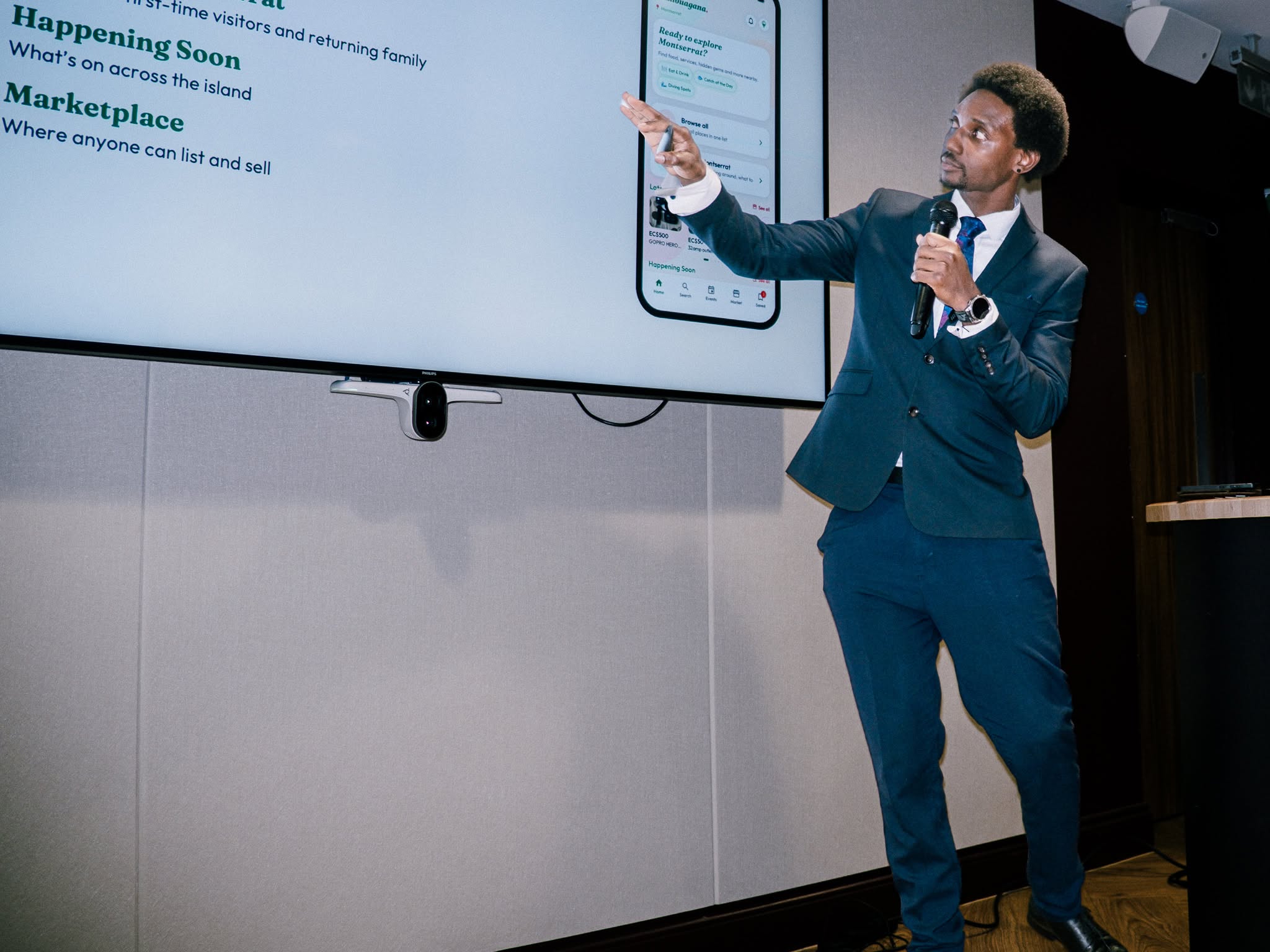
Tavez Aymer presented developments within the Simply Alliouagana digital platform, which now has more than 700 downloads across over 20 countries.
The platform features a business and services directory containing more than 196 listings and has recorded over 9,000 views.
New features include a Visiting Montserrat resource, an events directory and a marketplace where individuals and businesses can list products for sale.
Aymer explained that the marketplace was developed partly in response to the difficulty of finding products advertised across multiple social media groups, where listings can quickly disappear from view.
The platform is free to download and use, with its developers exploring opportunities for future partnerships and revenue generation to support its sustainability.
The demonstration also highlighted the potential for collaboration with Serra, Montserrat’s digital payment platform, to make transactions easier for residents and visitors.
Community organisations highlight the value of collaboration
Beyond government-led initiatives, the conference showcased the work of several diaspora organisations demonstrating how community-led projects can contribute to Montserrat’s development.
The Specca KPS Stream Academy presented an account of its activities since reconnecting former members of the Kingsale Primary School community in 2023.
Dr Gertrude Schott outlined the organisation’s work in education, culture, publishing and community engagement, including the publication of From Babes to Protégé and Beyond and its participation in cultural and educational programmes across the Caribbean, UK and North America.
The organisation also described its collaboration with the Alliouagana Singers and its plans to expand its educational activities through the academy.
Dr Rudi Page outlined the 2027 theme, Pathways to Transformation, identifying five areas of focus: the transition from analogue to digital systems, culture to creative economy, destination to geography, community development to sustainable livelihoods, and government to industry.
The presentation emphasised the importance of connecting education with emerging industries, developing practical skills and creating opportunities for young people to participate in economic development.
Author, poet and storyteller Myrle Roach meanwhile demonstrated how cultural heritage can be used to strengthen national identity and engage younger generations.
Presenting as Alliouagana Pearl, she shared her work developing Montserrat’s Mystery Mermaid folk tale into a storytelling and educational resource for children.
Inspired by stories of a mermaid said to have lived on Chance’s Mountain, Roach has worked with Montserratian artist Zana Kentish Braid to develop illustrations, colouring activities and rhymes to bring the story to life.
Her work has reached children in the UK through libraries and storytelling festivals and has also been incorporated into educational activities in Montserrat.
Roach said preserving and sharing local stories was important not only for introducing Montserrat’s culture to wider audiences but also for passing that heritage to younger generations and building national pride.
Crime prevention and community safety
The conference also included a presentation on Crime Stoppers Montserrat, an anonymous reporting service established through collaboration between Crime Stoppers UK, the Royal Montserrat Police Service and the UK Government.
Kate Johnston, Director of Business Development at Crime Stoppers UK, explained that the service provides a confidential way for people to share information about crime without identifying themselves.
Reports submitted through the online platform are received by Crime Stoppers in the UK and passed to a designated contact within the Royal Montserrat Police Service.
Johnston encouraged diaspora members to help raise awareness of the service among family, friends and community networks.
The Premier emphasised the importance of anonymous reporting in a small society where close family, church and social connections can make it difficult for people to report serious offences, particularly those involving vulnerable individuals.
A call for continued engagement
The conference concluded with an opportunity for participants to engage with the Premier and network with representatives of the various organisations.
Throughout the presentations, a recurring message was that the contribution of the diaspora extends beyond financial assistance. Professional expertise, business relationships, mentoring, cultural preservation, volunteering and advocacy were all identified as ways Montserratians overseas can support the island.
The discussions also highlighted the importance of stronger coordination between government, community organisations, businesses and individuals to ensure that opportunities translate into tangible results.
With the new Sustainable Development Strategy moving towards public consultation in January 2027 and the diaspora database now open for registration at diaspora.ms, the conference provided several practical avenues for continued participation.
Under the theme One Montserrat, Building Connections and Shaping the Future, the event reinforced the message that geographical distance need not limit involvement in the island’s future.
Montserrat’s diaspora is being encouraged to move beyond maintaining connections with home and become an active partner in shaping the country’s next chapter.
Discover more from Discover Montserrat
Subscribe to get the latest posts sent to your email.

