
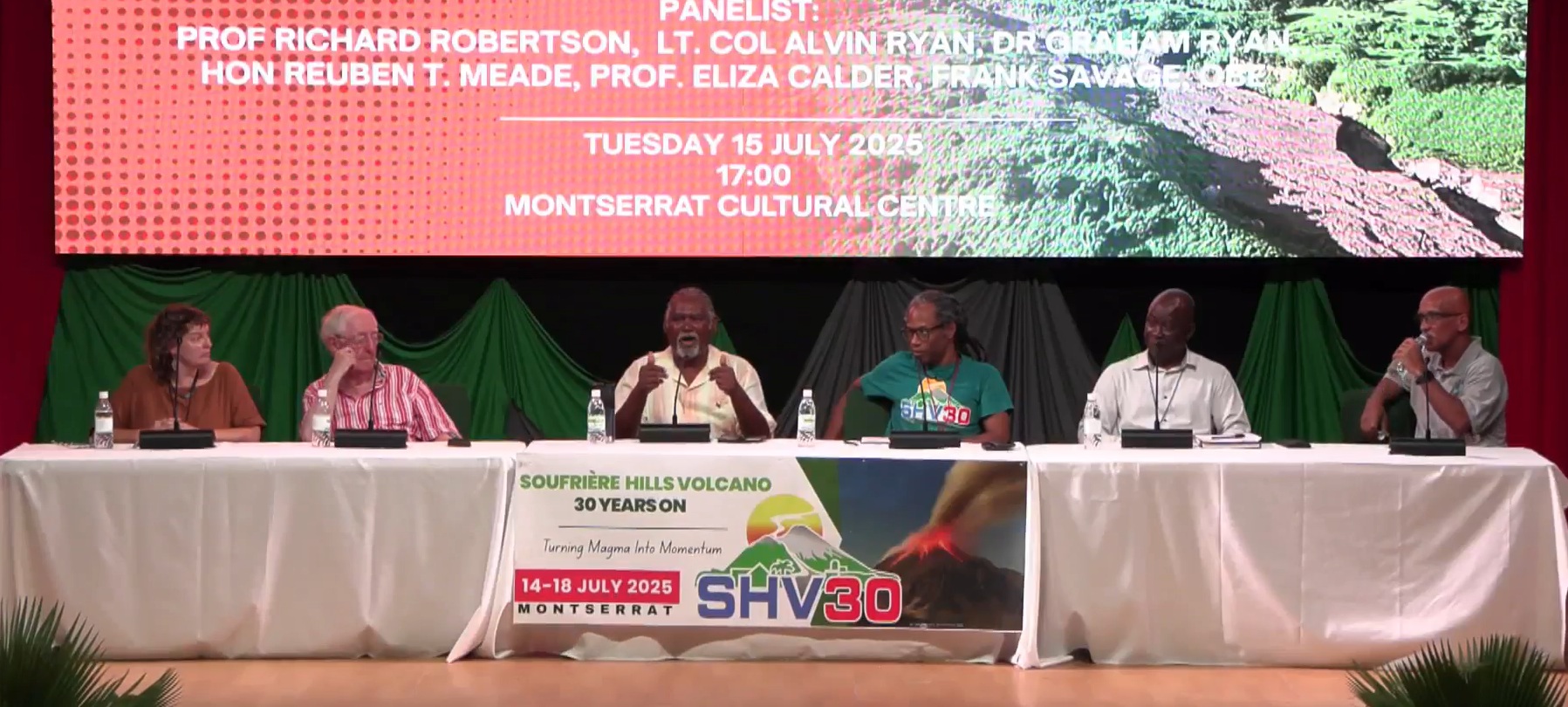
As Montserrat marked 30 years since the start of eruptions at the Soufrière Hills Volcano, a distinguished panel of scientists, government officials, and disaster experts gathered Monday evening to explore what’s next for the island’s southern region, still largely off-limits since the devastation of the 1990s. The session, held as part of the SHV30 conference, was themed Looking South: What Next?, and brought to the surface long-simmering tensions between scientific caution, political will, and community desire for progress.
Moderated by Shirlian Queeley of the Disaster Management Coordination Agency (DMCA), the panel included Premier Reuben T. Meade, MVO Director Dr. Graham Ryan, Professor Eliza Calder (Chair of the Scientific Advisory Committee), former Governor Frank Savage, Lieutenant Colonel Alvin Ryan of the DMCA, and geologist Dr. Richard Robertson.
Science Says: Opportunities Exist
Professor Calder, who has worked on Montserrat’s volcano since 1996, highlighted that scientific knowledge now enables more nuanced decision-making about parts of Zone V, if used correctly.
“There is the scientific information on which to make fairly detailed decisions…about where in Zone V may be possible to consider certain activities,” Calder said. “I’m not talking about long-term infrastructure, but activities that make best use of this window of opportunity while the volcano is quiet.”
She added that hazard maps already exist showing probabilities of pyroclastic flows and ballistic impacts, yet these remain underutilised in development planning.
Plymouth’s Potential and Political Hesitancy
Premier Meade shared an extensive list of proposed initiatives to revitalise the southern region, including transforming Plymouth into a UNESCO Global Geopark, restarting sand mining at Fort Ghaut, and launching geothermal energy production by September. He was particularly critical of outdated risk perceptions.
“We must never look at the volcano as a crisis,” Meade said. “Why can’t persons go and hunt animals in the south to make a living? Why is it that a farmer harvesting two goats in the exclusion zone could be arrested?”
He confirmed the Cabinet has agreed to restore water to the Foxes Bay area and mentioned plans for agriculture, tourism and hot spring development. “Let us be the ones to determine what trees grow in the South, not the birds.”
But Meade also slammed fellow politicians for lacking resolve: “Over 90% of the politicians have never read a SAC report. So how will they make decisions about utilising the lands we have?”
MVO: “We Don’t Set Policy – We Inform It”
Dr. Graham Ryan, Director of the Montserrat Volcano Observatory (MVO), emphasised that the role of the MVO is not to make decisions, but to provide clear data for policymakers.
“Our role is really to feed information to the Premier, the Governor, and others so they can make the best decisions,” Ryan explained. “The risk of a sudden event is very low…but the chance of eruption resuming in the coming decades is still significant.”
Ryan added that more effort could be made to translate scientific risk into relatable terms. “Maybe we need to compare it to something like walking through certain streets in London. That might resonate more.”
A Call for Imagination and Accountability
Dr. Richard Robertson delivered one of the evening’s most impassioned interventions, calling for Montserratians to “reimagine the South” together, not just wait for politicians to act.
“You need to bring the people in with you,” Robertson said. “I’ve been here long enough to see politicians come and go. And frankly, I think there’s been a failure of leadership, both politically and scientifically.”
Robertson urged the MVO and SAC to collaborate more actively with civil authorities to determine acceptable risk levels and define actionable pathways forward.
He suggested that the focus should be on the opportunities, rather than the challenges as they were part of life. The scientist also suggested that Montserrat needed to leverage their very powerful Diaspora who are even more deeply connected to the island because of the volcanic eruptions.
“What I see is people marking time. You’re living but not quite living. You need to build back that heart.”
Weak Governance and Risk Aversion
Lieutenant Colonel Alvin Ryan echoed concerns about policy inertia. “A lot of this boils down to risk appetite,” he said. “If you don’t control your own destiny, you have issues.”
He advocated strongly for constructing a bridge across the Belham River to enable reliable access to the south. “That’s the first thing you should be thinking about.”
Ryan confirmed his agency is ready to operationalise approved plans, but urged political leaders to be decisive and back proposals with tangible documentation.
Former Governor Offers Support
Frank Savage, Governor during the peak of the crisis in the mid-1990s, recalled Plymouth’s vibrant condition just before the 1995 eruptions and called for a “determined effort” to attract media and volcanology tourism.
“I don’t think we should find it hard to sell Montserrat,” Savage said. “But we’ve got to have the story ready to tell, and the book ready for them to take back.”
He also supported the idea of reviving a senior advisory body similar to SAC, “to take another fundamental look” at the long-term risks and potential of the island.
The Final Word: From Opportunity to Action
In closing remarks, Calder reiterated that many of the current risks in Zone V were lower than everyday dangers elsewhere on the island.
“Mining, tourism traffic, and road hazards are statistically more dangerous than volcanic activity in most of Zone V right now,” she said.
She called for focus on actionable change: “Let’s stop worrying about the volcano and start mitigating the manmade risks that are actually impeding development.”
The panel agreed that the key to Montserrat’s future lies in shifting the narrative from fear to informed opportunity.
As Robertson put it: “The land is there. The knowledge is there. What’s missing is the collective will to move forward.”
As the SHV30 conference continues, stakeholders and citizens are being urged to revisit the SAC and MVO reports, demand accountable leadership, and participate in reimagining the South, not as a ghost town, but as the foundation of Montserrat’s next economic chapter.
Discover more from Discover Montserrat
Subscribe to get the latest posts sent to your email.

