
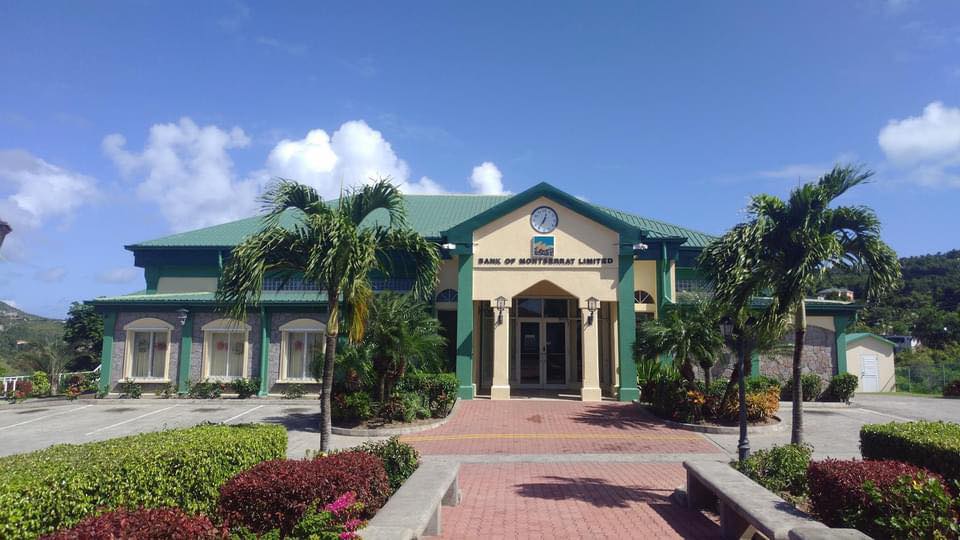
A proposal floated by Premier Reuben T. Meade to sell a portion of government’s shares in the Bank of Montserrat Ltd. has reopened an uncomfortable but necessary conversation about the future of banking on the island.
The question is simple but consequential.
Is partial foreign ownership the path to restoring services residents and visitors increasingly expect. Or does it introduce risks to one of Montserrat’s most important financial institutions?
Speaking to media following regional meetings last Friday, Premier Meade, who is also the Minister of Finance, said government is exploring discussions with a UK-based bank that could potentially provide correspondent banking services and modern financial infrastructure.
He indicated the arrangement could involve selling a 20 percent block of shares in Bank of Montserrat Ltd..
“We may have to make some decisions that Montserratians may not like,” Meade said. “We may have to say to them, we would like to sell you a 20% block of shares in Bank of Montserrat so that at least they have some skin in the game.”
Government currently holds approximately 53 percent of the bank’s shares. Meade suggested that level of ownership may not be necessary if strategic partnerships can deliver stronger services.
“I don’t believe government should be holding 53% shares in a bank,” he said. “Let us reduce it to 30 or 33% and get the other 20% to a company that is showing interest and can provide service.”
He also pushed back against the idea that the institution should remain exclusively locally owned.
“We tend to be very myopic and we feel Bank of Montserrat must be owned only by Montserratians,” he said. “We have to get away from that.”
The Real Problem: Scale
Behind the debate over ownership lies a deeper issue.
Operating a modern bank on a population of just over 4,000 people is expensive.
When Royal Bank of Canada (RBC) operated in Montserrat as part of a regional network, the cost of technology, card processing, and ATM infrastructure was spread across multiple jurisdictions.
Once RBC exited the island in 2021, Bank of Montserrat Ltd. inherited the responsibility of maintaining those services alone.
That shift dramatically changed the economics of banking.
Former General Manager Baldwin Taylor explained the dilemma shortly after the transition.
Taylor said at the time that they were “giving active consideration to adding Visa and Mastercard services at their ATM, which currently only allows for local account withdrawals.”
Currently, card holders can withdraw cash from their Visa credit and debit cards at designated tellers within banking hours. Credit cards can also be used at local merchants using point-of-sale machines.
The real barrier to upgrading the ATM network is cost.
Taylor told ZJB Radio News that installing card services at ATMs would require an initial setup cost of nearly EC$1 million and annual recurring fees of about EC$300,000.
Based on transaction volumes, the investment could not be justified.
“From a cost-benefit standpoint it does not make sense,” Taylor said.
The reality is that Montserrat’s demand for cash withdrawals and card transactions does not match the infrastructure costs required to support them.
That gap has meant that while customers can now complete most transactions through the bank’s mobile app and online platform, challenges remain around ATM functionality, international card access, and the cost of maintaining cash infrastructure on a small island.
The Case for a Strategic Partner
Premier Meade’s proposal suggests a solution.
Instead of operating alone, Bank of Montserrat Ltd. could partner with a larger institution capable of providing technological and financial infrastructure, including whether residents and businesses choose UK-based card products amid global uncertainty.
“Here’s a triple A rated institution. What can I do with them,” the premier said. “Should I switch my credit card… from a US based credit card to a UK based credit card given some of the geopolitical issues with the United States?”
Meade said the model would depend on whether partners are willing to do business and on the terms they offer.
According to the premier, such a partnership could deliver services including:
- ATM networks capable of processing international cards
- Credit and debit card infrastructure
- correspondent banking relationships
- money transfer systems
- investment services
“It will be a condition that if you were to buy these shares… there will be legal conditions established that they will be obliged to provide certain services to the bank and the community in Montserrat,” Meade said.
The idea is that an international partner with an existing banking network could absorb the infrastructure costs that currently make those services uneconomical for Montserrat alone.
In theory, that would return the island to something closer to the shared regional model that existed under RBC.
The Risks
Selling a stake in the island’s only commercial bank is not without consequences.
Even a minority shareholding by an external financial institution introduces several potential risks.
Loss of influence over strategy.
While government would retain majority ownership, a strategic investor could influence decisions about services, lending priorities, or risk policies.
Profit extraction.
External investors typically expect returns. Profits generated locally could flow outward rather than being reinvested domestically.
Dependence on a single partner.
If the relationship deteriorates or the partner withdraws, Montserrat could again face disruption similar to the departure of RBC.
Public trust and perception.
For many residents, Bank of Montserrat Ltd. represents a national institution. Any reduction in local ownership could raise concerns about control.
At the same time, maintaining the status quo carries its own risks.
Limited financial services can discourage tourism, complicate business transactions, and frustrate residents who increasingly rely on digital payments and global banking tools.
A Practical Question
Ultimately the debate may come down to practicality.
Montserrat wants modern banking services.
But those services come with infrastructure costs designed for much larger economies.
The premier’s proposal raises a broader question.
Is a strategic partnership the only viable way for a small island bank to deliver global financial services?
Or is there another model that allows the Bank of Montserrat to remain fully local while still expanding its capabilities?
For now, Meade’s comments suggest government is willing to consider options that would once have been politically difficult.
The challenge will be balancing national ownership with the practical need for modern banking infrastructure.
Discover more from Discover Montserrat
Subscribe to get the latest posts sent to your email.