Storytelling, cultural heritage and greater opportunities for diaspora participation could play a significant role in Montserrat’s economic future, according to a paper presented by author and healthcare executive Wendell C. White at the 20th Annual Antigua and Barbuda Country Conference.
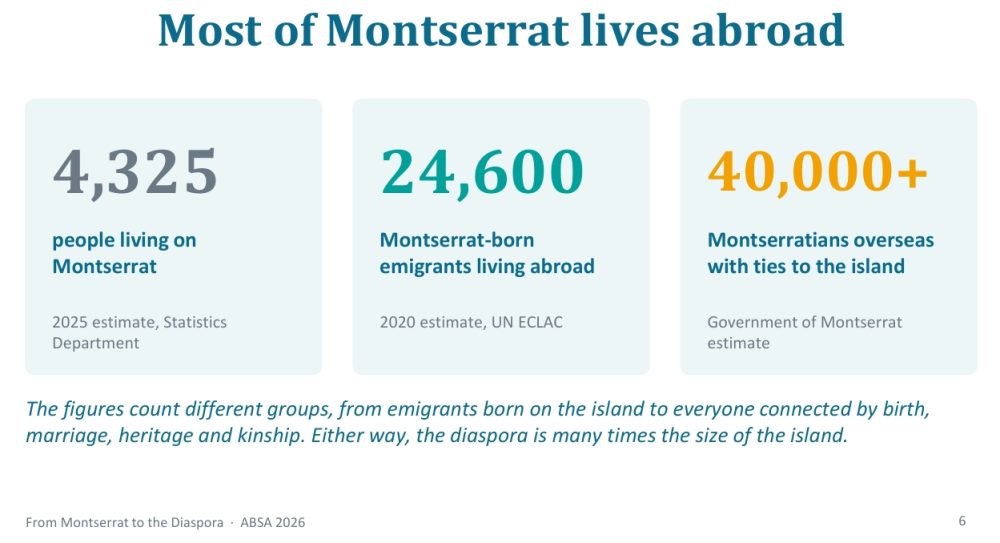
In his presentation, From Montserrat to the Diaspora: Storytelling, Cultural Memory, and the Eastern Caribbean Central Bank’s Big Push, White argued that Montserrat and other small Caribbean states must look beyond their resident populations and recognise the economic and human resources available within their global diaspora communities.
The conference, held on November 12 and 13, 2026, focused on engaging with the Eastern Caribbean Central Bank’s (ECCB) Big Push initiative, which aims to double the combined gross domestic product of the eight-member Eastern Caribbean Currency Union within ten years.
White’s paper explores how the diaspora could contribute to achieving that ambition, not only through traditional financial remittances but also through investment, professional expertise, skills, ideas and knowledge.
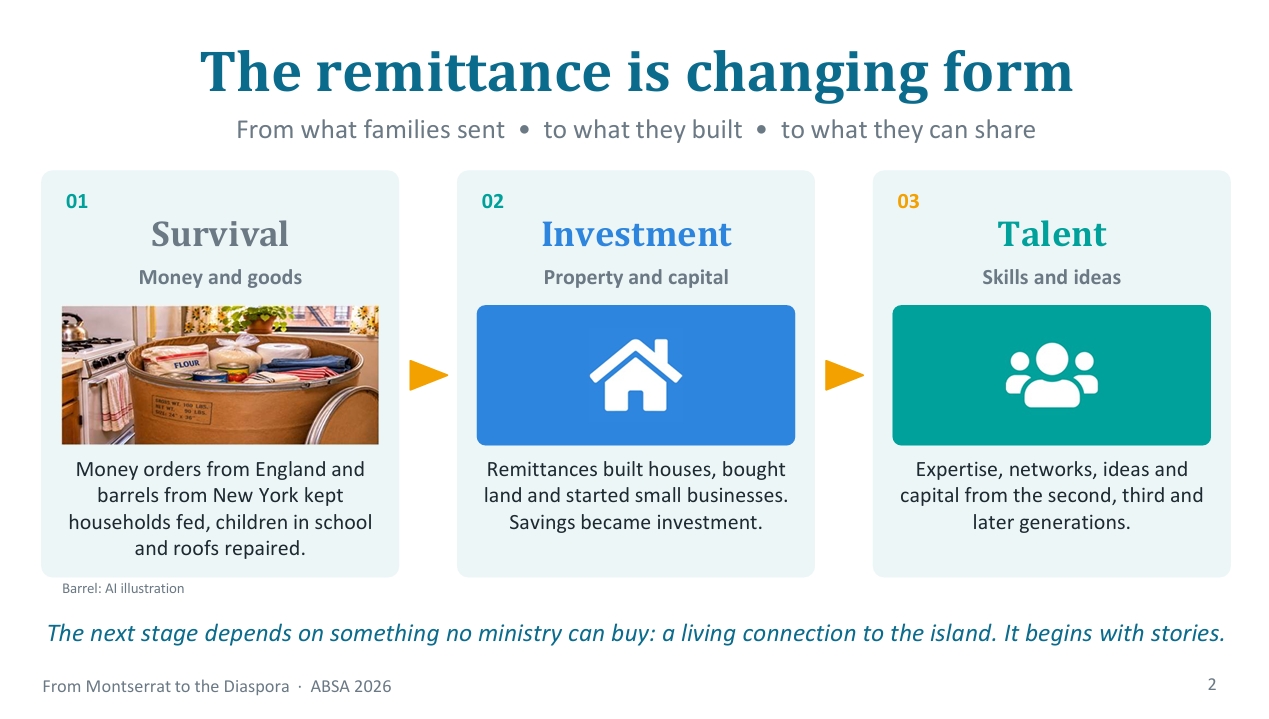
Drawing on his personal experience growing up in Montserrat before moving to the United States, White used the familiar tradition of the Christmas barrel to illustrate the evolving relationship between the island and its overseas communities.
He argued that what began as a means of supporting families through money, food and essential supplies has the potential to evolve into a more structured exchange of talent, investment and professional services.
However, he believes that maintaining a meaningful connection to Montserrat, particularly among younger generations born overseas, is essential to making this possible.
White ABSA 2026 Presentation – Final 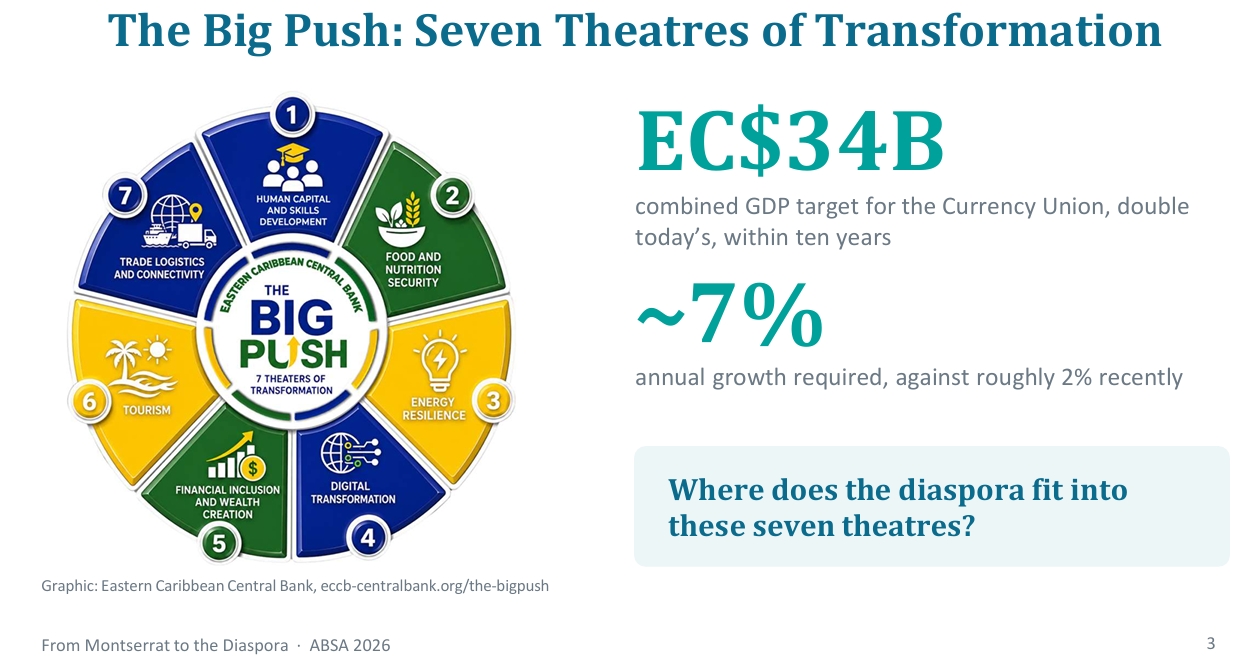
Diaspora willing to contribute, but needs opportunities
A key feature of the paper is a voluntary survey conducted by White between October 9 and November 1, 2026, involving 51 people with ties to Montserrat. The respondents included Montserrat-born individuals living overseas, descendants born abroad to Montserratian parents or grandparents, and people with other family connections to the island.
The findings suggest considerable willingness among respondents to contribute to Montserrat’s development if appropriate opportunities and channels were available.
Of those who answered the relevant questions, 44 of 48 (92 per cent) said they would be very or somewhat likely to share their professional skills if a clear opportunity existed. Similarly, 44 of 45 (98 per cent) expressed a willingness to mentor young Montserratians, while all 47 respondents who answered said they would support a community project.
Interest in investment was also significant, with 40 of 48 respondents (83 per cent) indicating that they would be likely to invest in a business or property on Montserrat if a clear opportunity existed.
The survey also identified some of the barriers preventing greater participation. Travel costs and limited air and sea connections were among the most frequently cited challenges, with 41 respondents identifying the cost of travel, limited flights or ferry access, or both.
Another significant obstacle was the lack of information about opportunities to contribute. Twenty-six respondents said they did not know what opportunities existed or had no clear way to offer their professional skills.
This challenge was particularly pronounced among younger generations born overseas. Of the 27 respondents born abroad to Montserratian parents or grandparents, 21 identified a lack of information or clear channels for contributing.
White noted that people who grew up on Montserrat often retain the networks that help them understand where assistance is needed, while their children and grandchildren may have a strong attachment to the island but lack the information and connections required to participate.
He acknowledged that the survey was voluntary and not statistically representative of the wider Montserratian population, but said the findings offered useful insights into the potential for deeper diaspora engagement.
Six recommendations for action
The paper proposes six areas of action for government and other stakeholders to help translate diaspora interest into meaningful contributions to national development.
These include establishing a central point of contact or Office of Diaspora Affairs to connect overseas Montserratians with opportunities and needs on the island, and simplifying processes relating to citizenship, residency and participation.
White also recommends reducing the barriers to investment and charitable contributions, improving digital and physical connections with the island, developing heritage travel opportunities for second and third-generation Montserratians, and investing in storytelling and culturally relevant literature in schools.
He places particular emphasis on the role of storytelling in preserving cultural identity and ensuring that younger generations understand their connection to Montserrat.
His work draws on his memoir, Summer Baby, and his Abby & Andy children’s book series, which explores Montserratian heritage and the experiences of children growing up between the Caribbean and the diaspora.
He argues that stories help build the sense of belonging that can encourage younger generations to visit, invest, pursue professional opportunities and contribute to their ancestral homeland.
The paper also highlights the potential of digital connectivity to facilitate the exchange of skills and services without requiring people to relocate to the island. Professionals living overseas could mentor young entrepreneurs, support healthcare services and provide expertise to local businesses and institutions remotely.
White further advocates for greater regional collaboration, particularly in areas such as healthcare, where small island states could share specialist services and professional resources rather than attempting to develop every capacity independently.
His central argument is that the diaspora should not be viewed simply as a source of remittances or a community of former residents, but as an important partner in the region’s economic transformation.
As the ECCB advances its Big Push agenda, White believes that connecting the skills, resources and experiences of Caribbean people at home and abroad will be essential to achieving sustainable growth.
Readers can explore White’s full paper, From Montserrat to the Diaspora: Storytelling, Cultural Memory, and the Eastern Caribbean Central Bank’s Big Push, which includes the survey findings and detailed recommendations, here: https://discovermni.com/wp-content/uploads/2026/11/White-ABSA-2026-Presentation-Final.pdf
Discover more from Discover Montserrat
Subscribe to get the latest posts sent to your email.