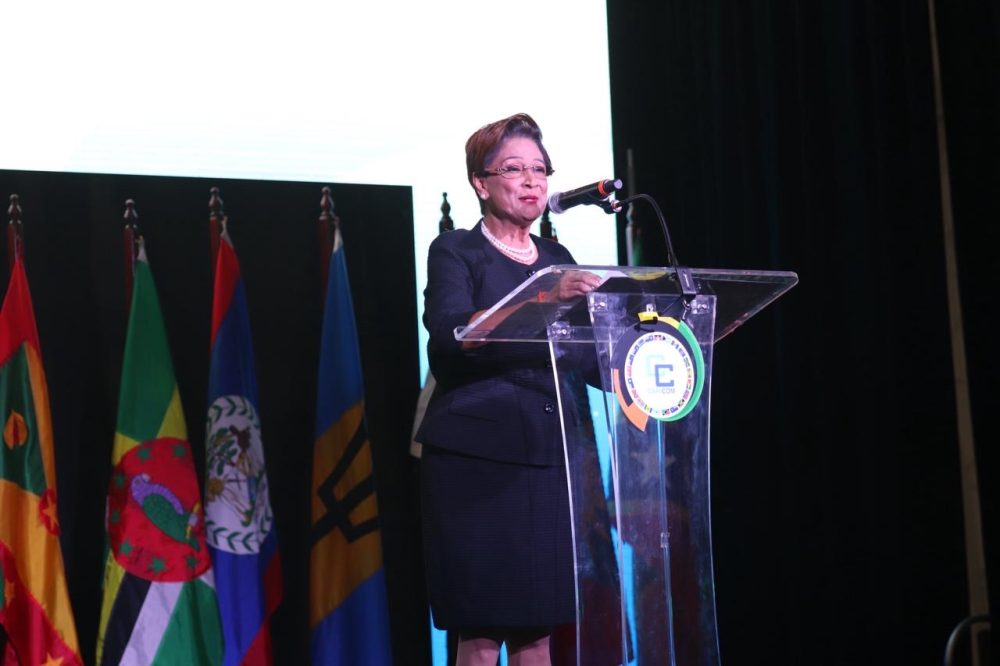
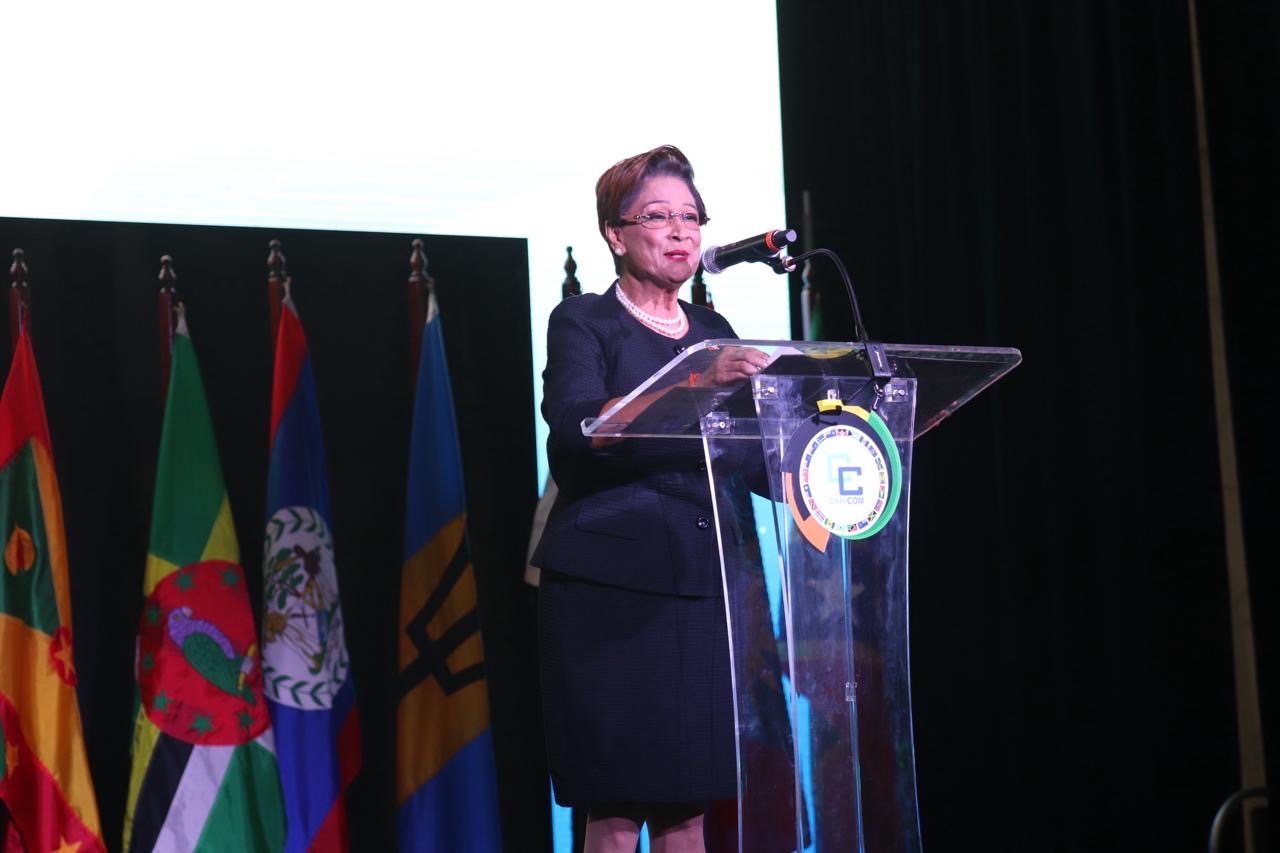
Prime Minister of Trinidad and Tobago, Kamla Persad-Bissessar, used her address at the opening of the 50th Regular Meeting of the Conference of Heads of Government of CARICOM on Tuesday, February 24, 2026 to deliver one of the most direct and politically charged interventions of the evening.
Speaking at the Marriott Hotel in St Kitts and Nevis, Persad-Bissessar began on a lighter note, reflecting on the growth in female leadership across the Region.
“There was a time when it was just two of us. First it was me and then it was Mia [Mottley, Prime Minister of Barbados]. And then it was Mia and it was me again. And now it’s me again,” she said, congratulating the new President of Suriname Dr. Jennifer Geerlings-Simons.*
She shared a humorous anecdote from her time as Minister of Education and then her tone shifted sharply as she turned to matters she described as “the reality of what is happening in my own country, Trinidad and Tobago”.
Persad-Bissessar reaffirmed her country’s commitment to regional integration but insisted that sovereignty and national security priorities must take precedence.
“Going forward, we will work with the CARICOM. We are invested in the CARICOM. We’ve been there from day one, and we want to be there after the end and the beginning and in the end,” she said.
However, she argued that Trinidad and Tobago “cannot bind ourselves to the same political ideologies, the same foreign issues, and the same security policies of the entire CARICOM”.
She referenced what she described as CARICOM’s “unreliability” in past situations, including the unresolved 2022 matter in which she said a Trinidad and Tobago citizen was “kidnapped” from another CARICOM state and returned to Trinidad using a Regional Security System aircraft. She reiterated that, despite writing to the CARICOM Secretariat in 2022, she has not received a response.
“That response, non-response, it may be the result of poor management, lack of accountability,” she said, adding that CARICOM “should be the voice for all, not just for the governing parties.”
Security Cooperation with the United States
Persad-Bissessar devoted a significant portion of her remarks to national security and crime, drawing a direct link between regional security realities and her government’s closer cooperation with the United States.
“Thanks to President Trump. Thanks to Secretary Rubio and the U.S. military, I say thank you… for standing firm against narco trafficking, human and armed smuggling originating from Venezuela,” she said.
She disclosed that Trinidad and Tobago recorded 620 murders in 2024 within a population of 1.4 million, with 40 percent described as gang-related and linked to narcotics and firearms trafficking.
“In 2025, change of government, changed the policy to treat with the drug cartels and the gangs as violent terrorist organizations,” she said.
She credited U.S. military action in the Caribbean with contributing to a 42 percent reduction in murders.
“That’s 257 less people who would have been dead had we not taken that course of action,” she stated.
Persad-Bissessar made clear that her government would continue cooperation with the United States in what she described as efforts to “drive destabilizing and destructive forces out of our country, out of our region”.
She argued that while CARICOM promotes the Caribbean as a “zone of peace”, countries like Trinidad and Tobago face security threats that require decisive external partnerships.
“Some of us, the crime is so bad, I cannot depend on just my military, my protective services, and certainly from you in the CARICOM,” she said.
Full and Free Movement
On the issue of full and free movement within CARICOM, Persad-Bissessar said Trinidad and Tobago remains committed “in principle” but is grappling with significant illegal migration pressures.
She noted that tens of thousands of undocumented migrants have entered Trinidad and Tobago, placing “an enormous strain” on public services and taxpayers.
“At this time… Trinidad and Tobago, we are fully committed in principle to the full and free movement, but we have to deal with the thousands of illegal ones I already have in my country,” she said. “So I will say not at this time.”
Cuba, Democracy and Haiti
The Trinidad and Tobago Prime Minister also addressed Cuba, questioning what she described as contradictions within regional discourse on democracy.
“Every single leader in this room was elected by a free and fair democratic election,” she said. “Why do some CARICOM governments and political parties believe that they… should have the right to contest democratic elections… while the Cuban citizens have no right?”
She stated that Trinidad and Tobago would not support “a dictatorship in Cuba or anywhere else”, and outlined democratic principles including rule of law, separation of powers, accountability, freedom of expression and multiparty elections.
Turning to Haiti, she described democracy there as being under sustained threat from armed gangs, political collapse and food insecurity.
“We support the United States and Panama’s proposed gang suppression force to subdue violent gangs and to help restore order in Haiti,” she said, adding that Trinidad and Tobago is prepared to share intelligence to assist.
Commitment, But On Its Own Terms
Despite the pointed criticism and firm positions articulated, Persad-Bissessar closed by reiterating her country’s long-standing ties to the Region.
She referenced her personal history of studying and lecturing in Jamaica, living in Barbados, and her family’s deep connections across the Caribbean.
“I began by reaffirming Trinidad and Tobago’s commitment to CARICOM,” she said.
Her address injected a blunt realism into the ceremonial proceedings, placing sovereignty, security and democratic accountability at the centre of her country’s engagement with the regional body.
As the Conference continues through Friday, leaders will deliberate on regional integration, climate resilience, economic coordination and foreign policy alignment. Tuesday’s opening made one thing clear. Unity remains the goal, but the pathways to it are increasingly contested.
*The first female leader of CARICOM was Dame Eugenia Charles of Dominica. Other female leaders include Portia Simpson Miller of Jamaica and Janet Jagan of Guyana.
Discover more from Discover Montserrat
Subscribe to get the latest posts sent to your email.