A diaspora-led initiative proposing a new private healthcare system for Montserrat has set a US$6 million target for its first phase, with organisers hoping to begin implementation as early as February 2027.
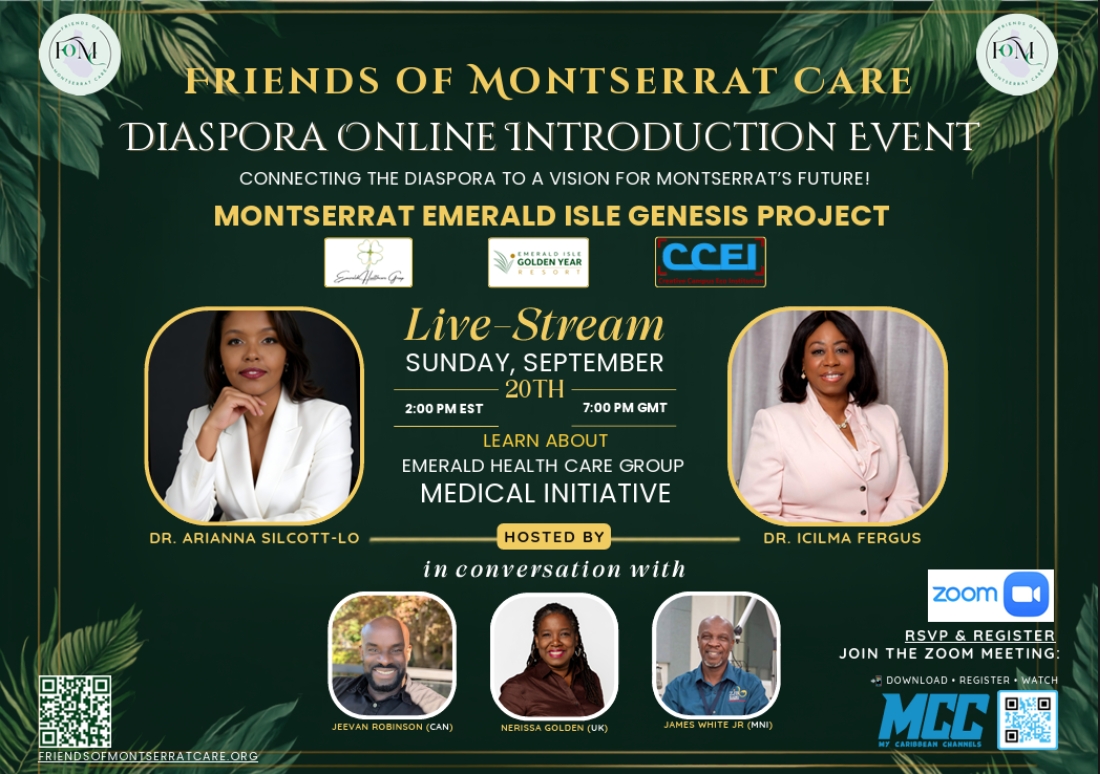
The plans were outlined on Sunday during Advancing Healthcare in Montserrat and the Caribbean, an online introduction hosted by Friends of Montserrat Care. The session featured Dr Icilma Fergus-Rowe, a cardiologist and professor of medicine at Mount Sinai in New York, and healthcare executive Dr Arianna Silcott-Lo, co-founder of Emerald Healthcare Group.
The organisers presented a two-phase vision beginning with mobile medical units, laboratory services and rotating specialists. The longer-term proposal is for a 380,000-square-foot academic medical centre linked to a residential development for people aged 55 and over, medical tourism, education and sports medicine.
However, the event also revealed that several of the financial, legal, operational and regulatory details needed to evaluate the project have not yet been made public.
At the start of the session, Dr Fergus-Rowe cautioned that the initiatives remain in planning and development. She said the proposed timelines, facilities, partnerships, budgets and services are subject to fundraising, approvals, formal agreements, professional review and community consultation.
What is proposed for Phase One
Dr Silcott-Lo said Phase One would introduce a state-of-the-art laboratory, mobile units and visiting medical specialists. Dr Fergus-Rowe said the early model could include at least one physician and two nurse practitioners, supported by other healthcare professionals.
The organisers envision specialists rotating through Montserrat monthly, with different areas of medicine available at scheduled intervals. They said doctors, nurses, physician assistants, educators and technicians have already expressed an interest in participating, with some prepared to volunteer initially.
No complete list of participating specialists, written commitments or proposed rotation schedule was presented during the launch.
Dr Fergus-Rowe said diabetes, hypertension, cardiovascular disease, kidney disease, paediatrics and maternal health are among the areas requiring attention. Her assessment was based partly on patients seen during medical missions to Montserrat dating back to approximately 2011.
She described the case of a patient whose poorly controlled diabetes eventually resulted in the loss of a leg as an example of the consequences of delayed intervention and inadequate disease management.
According to Dr Fergus-Rowe, the initiative could strengthen screening, diagnosis, treatment, health education and preventive care.
The clinical case for improving access to specialist and preventive services is clear. What was not presented was a formal health-needs assessment showing the number of patients requiring each service, the current capacity of the public system or the specific gaps Phase One would fill.
US$6 million sought by February
Near the end of the discussion, Dr Silcott-Lo placed the estimated cost of Phase One at US$6 million. She said the organisers hope to have the full amount, along with a land agreement, in place before the proposed February 2027 start.
“Yes, the estimated start date is February of 2027, and we’re hoping to have all of the entire $6 million and the land accord, everything in our hands, ready to go,” she said.
Funding is expected to come from fundraising events, donations and private investors. A launch event is scheduled for November 18 in Manhattan.
Dr Silcott-Lo said investor discussions were taking place but could not provide details because of non-disclosure agreements.
“There’s a lot of investors on the table right now with that conversation, but also through our galas and our events that we’re going to be having, that money and that fundraising will come into play,” she said.
No amount was identified as having already been raised or committed. The organisers also did not provide a breakdown showing how the US$6 million would be spent, what facilities or equipment it would purchase, how much would be allocated to staffing, or how long the funding would sustain operations.
A February 2027 start would require the organisation to complete fundraising, secure land, obtain planning and healthcare approvals, finalise its operating structure, procure equipment and establish staffing arrangements within approximately five months.
No detailed implementation schedule was presented showing how those milestones would be achieved.
An US$800 million longer-term vision
Phase Two is significantly larger. Dr Silcott-Lo estimated that developing the academic medical centre, the Emerald Isle Golden Years Resort, educational facilities, sports medicine services and the medical tourism component could cost approximately US$800 million.
The organisers said the proposed medical centre would serve Montserrat while attracting patients from neighbouring islands, the wider diaspora and international markets.
Medical tourism and regional patient referrals are central to that model because Montserrat’s resident population alone could not financially sustain a medical centre of the size proposed.
Dr William Meade Jr, one of the participants, said the distinction between providing affordable healthcare for Montserratians and developing a commercially viable private hospital needed to be clearly defined.
“There’s no way a 5,000 population can sustain this hospital, this state-of-the-art hospital,” he said.
Dr Fergus-Rowe agreed that the local population would not be sufficient. She said regional patients, international clients and medical tourists would be needed to generate revenue.
No regional market study, projected patient volume, competitive analysis or medical tourism feasibility study was shared during the session. Montserrat’s limited air and sea access was also identified as a major constraint.
Dr Silcott-Lo said the proposed medical centre would be designed to accommodate medevac services and that discussions were under way with a vendor. However, the ability to land a medical evacuation aircraft at a future facility would not by itself resolve the wider challenge of bringing patients, healthcare professionals, supplies and construction materials to Montserrat.
Relationship with the Government remains unclear
Dr Silcott-Lo said the organisers have held discussions with the Government of Montserrat and that an MOU is in place for a government-private partnership.
“We do have a MOU in place that we are a government-private partnership,” she said.
No representative of the Government of Montserrat participated in the presentation to confirm the arrangement. The MOU was not shown, and its parties, terms and scope were not disclosed.
At other points, the initiative was described as private, separate from government and not dependent on government subsidies.
The organisers said Emerald Healthcare Group would coexist with Glendon Hospital and provide services or technology unavailable through the public system. However, questions remain about referrals, shared personnel, use of public facilities, government subsidies for patients, clinical oversight and how the private initiative would align with the new national hospital now under development.
These details are critical. A private clinic cannot meaningfully complement the public system without agreed pathways covering referrals, emergency care, patient records, staffing and responsibility for payment.
Who will pay for care?
One of the most important questions raised concerned whether Montserrat residents would be able to afford the proposed services.
Dr Silcott-Lo said Friends of Montserrat Care is registered in the United States as a non-profit organisation. She said donations and fundraising would help cover services for people unable to pay and that access would not be limited.
“I don’t want anybody to necessarily apply for it. I want it so that if they’re on an acute standpoint where they need the surgery here now or yesterday, there is no application process,” she said.
The aspiration is significant, but no financial mechanism was presented to show how the organisation would guarantee on-demand care without an eligibility process, particularly for expensive surgery, hospitalisation or long-term treatment.
Dr Silcott-Lo also said patients from the United States could use their insurance. A participant with healthcare revenue experience noted that US Medicare and the national health systems in Canada and the United Kingdom generally do not provide a straightforward route for paying for overseas services. International private insurance or a separately negotiated public funding arrangement may therefore be required.
The session did not establish what residents would pay for consultations, tests or procedures; which insurers would be accepted; how many patients would be subsidised; or who would cover care when donations were insufficient.
Legal and governance structure needs clarification
Friends of Montserrat Care was described as a New York-based organisation and a US-registered non-profit. The healthcare operation was also described as having both non-profit and profit-generating components.
Dr Fergus-Rowe said the private component would generate income through healthcare services, while the non-profit arm could receive restricted funding for education and professional development.
The relationship between Friends of Montserrat Care, Emerald Healthcare Group and any Montserrat-based operating company was not fully explained. A question about the number of legal entities, their place of registration and their local operating arrangements was interrupted by technical problems and was not subsequently answered in detail.
Potential supporters still need to know:
- Who owns and controls each entity.
- Who sits on the governing boards.
- Whether Montserrat residents will have board representation.
- Which entity will receive donations.
- Which entity will own the land, buildings and medical equipment.
- How funds will move between the non-profit and commercial operations.
- What financial reporting and independent auditing will be provided.
- What return, control or ownership rights private investors will receive.
The answers to these administrative questions determine whether a contribution is a charitable donation, a commercial investment or support for a company over which the donor has no continuing interest.
Sustainability has not yet been demonstrated
The presenters repeatedly said the healthcare operation would eventually become self-sustaining through fees, insurance payments, regional patients, medical tourism and other revenue streams.
Dr Fergus-Rowe cited a previous specialist visit during which she said fees from approximately 50 to 60 patients generated more than EC$70,000 for the Government of Montserrat in one week.
That experience indicates there is demand for specialist services. It does not establish that the proposed operation could cover the recurring cost of doctors, nurses, technicians, insurance, medical supplies, pharmaceuticals, equipment servicing, utilities, accommodation and international travel.
No operating budget, revenue forecast, break-even analysis or projected patient numbers were disclosed.
The project’s reliance on volunteers during its initial stage may help reduce costs, but a permanent healthcare system cannot depend indefinitely on unpaid specialist labour. The organisers acknowledged that professionals would eventually need to be compensated.
Patient records and regulation
In response to questions about patient information, Dr Fergus-Rowe said electronic medical records would be kept within the institution and protected under US patient privacy standards.
However, it was not stated which entity would own the records, where the data would be stored, which national laws would apply or how overseas practitioners would be authorised to access the system.
The presentation also did not address professional licensing, malpractice coverage, institutional accreditation, medication control, clinical governance, research ethics or the process through which a private healthcare facility would be authorised to operate in Montserrat.
Experience and commitment are evident
The initiative has several genuine strengths. It is being advanced by members of the diaspora with professional healthcare, business and community experience. Dr Fergus-Rowe has an established record of providing specialist services in Montserrat without compensation, and local nurse Brenda Daley spoke during the session about the quality of the care and training previously delivered by her teams.
The project also addresses a recognised problem. Montserratians regularly travel overseas for specialist consultations, tests and procedures, adding transportation and accommodation costs to already expensive medical care.
The proposed first phase may offer an opportunity to test demand, collect health data and determine whether more frequent specialist visits can improve continuity of care. It could also measure whether patients from neighbouring islands would travel to Montserrat for particular services.
What potential supporters still need
Sunday’s event introduced the vision, the proposed phases and the people leading the healthcare component. It did not provide enough verified information for someone to assess the project as an investment opportunity or to conclude that it will improve healthcare in Montserrat.
Before being asked to donate or invest, prospective supporters would reasonably need to see:
- A formal health-needs assessment.
- A Phase One feasibility study and detailed business plan.
- A breakdown of the US$6 million budget.
- Evidence of funds already raised or contractually committed.
- The proposed site and proof of a land agreement.
- The MOU said to exist with the Government of Montserrat.
- A clear legal and governance structure.
- A list of confirmed medical partners and specialists.
- A licensing, regulatory and accreditation pathway.
- An operating budget and long-term revenue model.
- A patient fee, insurance and subsidy framework.
- A regional demand and medical tourism study.
- Plans for transportation, emergency transfers and follow-up care.
- Policies for financial oversight, patient safety and data protection.
- Measurable milestones against which the February 2027 target can be assessed.
The organisers said additional discussions will be held and more information shared ahead of and during the November event in New York.
The healthcare need and the organisers’ commitment were evident during the launch. The next stage will require more than passion and professional goodwill. It will require documented agreements, independent analysis, transparent finances and a practical implementation plan capable of showing residents, donors and investors exactly what can be delivered, when it can be delivered and who will be accountable for the outcome.
Learn more about the organisation and their planned initiatives at https://friendsofmontserratcare.org/
Discover more from Discover Montserrat
Subscribe to get the latest posts sent to your email.