MONTSERRAT – Authors from Montserrat and the wider Caribbean literary community showcased their latest publications during a special Books at the Library session on Saturday, November 14, at the Montserrat Public Library, as part of the 2026 Alliouagana Festival of the Word.
Hosted by festival coordinator Gracelyn Cassell, the session brought together authors presenting both in person and virtually, providing an opportunity to share their work, discuss their creative journeys and reflect on the role of artificial intelligence in contemporary writing.
The presentations formed part of this year’s festival theme, To Bot or Not: Originality in the Age of AI, with authors offering differing perspectives on the use of technology in the creative process.
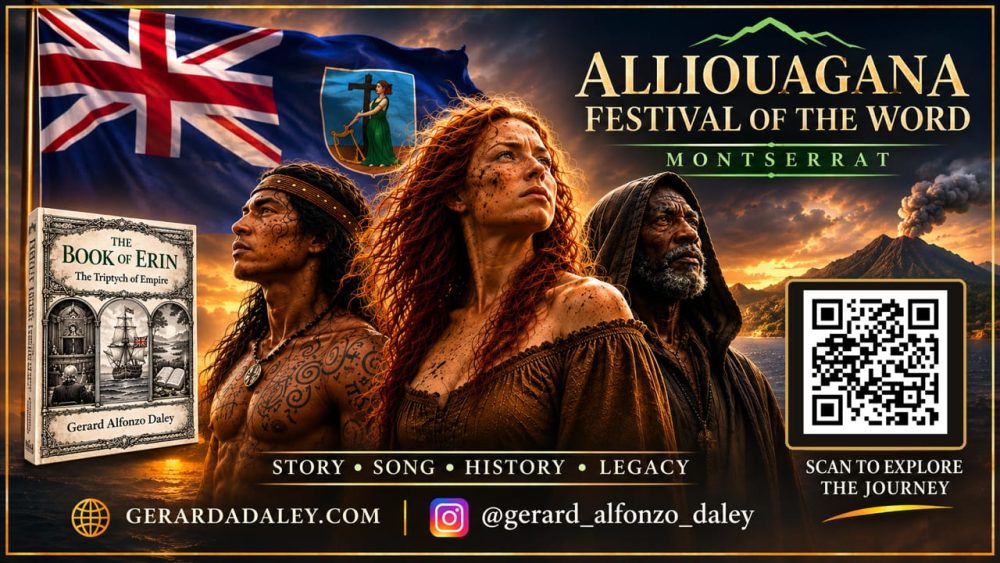
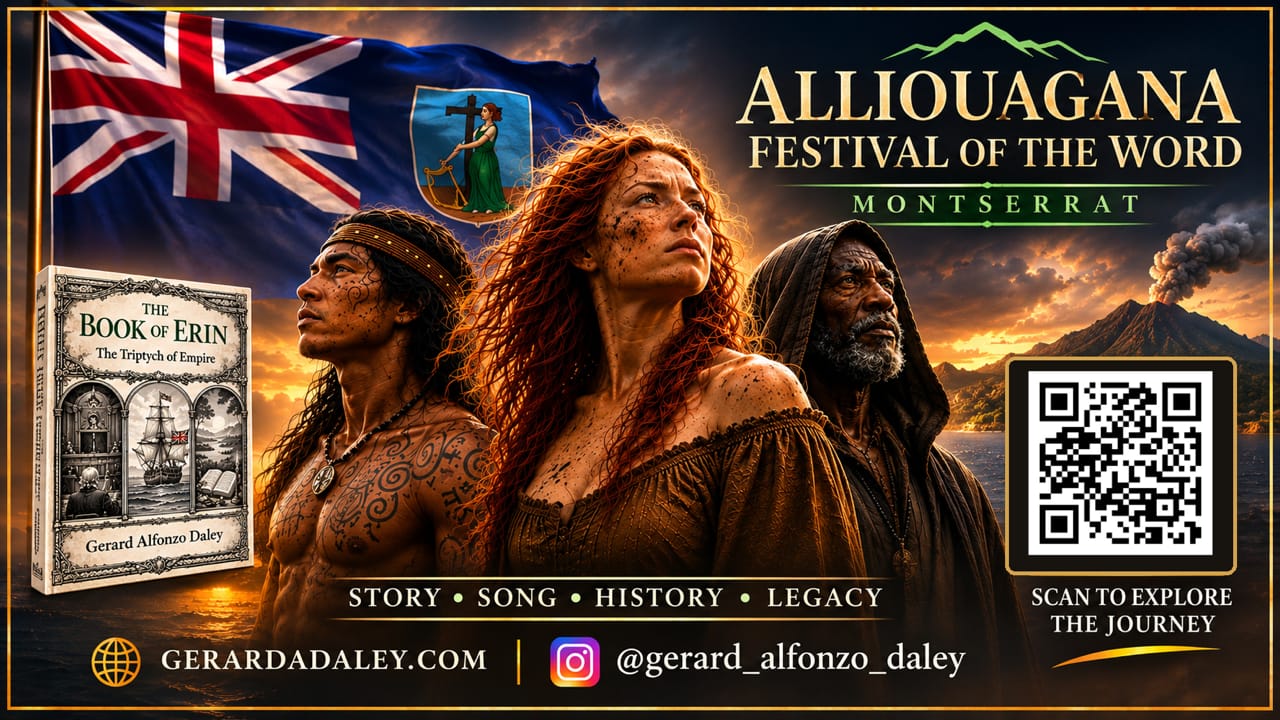
The first presentation came from Gerard Alfonso Daley, a Montserrat-born writer, songwriter and storyteller, who introduced his historical novel in verse, The Book of Erin (2026).
Daley explained that the inspiration for the book came from his curiosity about the woman depicted on Montserrat’s flag, whose name is Erin, the Gaelic word for Ireland. His research led him to the history of Irish indentured people transported to Montserrat during the 17th century, where they worked alongside enslaved Africans and indigenous people.
Written in verse, the book combines documented historical research with poetry. Daley described it as a triptych of empire, comprising the historical legislation, the poetic narrative and historical ledgers from the period.
He explained that the story had also developed into a wider creative project, with songs and films emerging from the original publication. Artificial intelligence had played a role in helping him transform verses into songs and develop visual material through filmmaking tools.
Daley shared a reading from the book, giving the audience a glimpse into the experiences of Erin and others caught up in the forced movement of people during that period.
Poet Hyacinth Edwards was next, presenting her collection A Bouquet of Hyacinths, published in 2025. Edwards, a longtime literary editor, explained that the collection explores the range of human emotions, including love, loss, loyalty and longing.
She read two poems, Prayer and Transformative Love, describing her writing as a deeply personal and emotional process informed by her own experiences and those of friends and relatives.
Addressing the festival theme, Edwards said the words and arrangements in her poems were her own, although she acknowledged that artificial intelligence may have contributed to the process of creating the photograph used on the book’s cover. She said she remained open to learning how to work with AI without losing her individual voice.
Her husband, Neville G. Weekes, joined the session virtually from Georgia to introduce his second poetry collection, Rhymes with Soul, published in 2026.
Weekes described the collection as an exploration of life, love, loss, wit and whimsy, with a particular focus on his personal experiences with mental health and the role poetry has played in his healing.
He explained that he had been writing for approximately four decades and published his first collection, Away with Words, in 2021. While acknowledging that artificial intelligence has its place, Weekes said he preferred to rely on his own creativity and experiences when writing.
He read his poem I Got You, which explores moments of emotional vulnerability, depression and uncertainty, and the reassurance of knowing that one is not alone.
The session also featured Marguerite Joseph, who presented her novel Lily and Lily of Eire, a sequel to her earlier publication, Lady Under the Stairs.
Drawing on her more than 30 years of experience in personal, social and community well-being, particularly in mental health and social care, Joseph explored themes of mental illness, resilience, love and social change.
She explained that the book draws on the story of Saint Dymphna, the seventh-century Irish patron saint associated with mental health, and follows the life of Lily, a woman who spent 25 years in a mental health facility before rebuilding her life and reconnecting with her family.
The novel traces a journey from confinement to freedom, isolation to love, and survival to social change. Joseph said she used a combination of approaches when it came to artificial intelligence and the creative process.
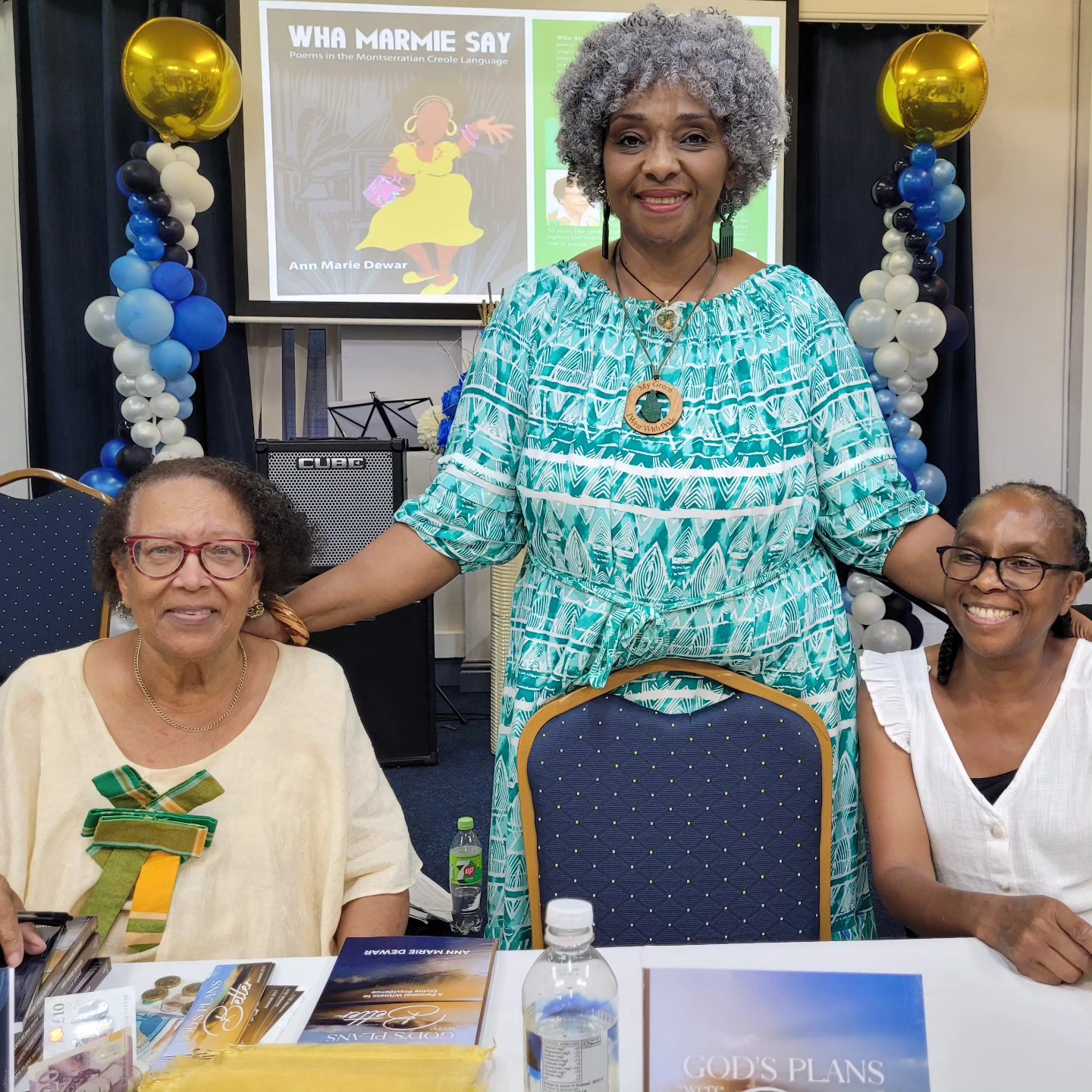
Another Montserrat author featured was Vanesta Peggy Lewis, whose book Oswald Street was presented by fellow author Ann Marie Dewar.
Lewis, who grew up in the eastern village of Streatham, was forced to relocate to the United Kingdom during the volcanic crisis. Her book draws on her experiences growing up in Montserrat and explores the influence of landscape, family and community on personal development.
Dewar read from an introduction provided by Lewis, highlighting the importance of the environment in shaping identity and the memories of village life.
The book explores themes including the role of women, poverty, education, family, community, forgiveness and reconciliation. Dewar also shared an extract recalling childhood fears of the road between Streatham and Dyer’s, including the jumbie stories that formed part of the island’s oral tradition.
She described Oswald Street as a deeply personal and nostalgic account that captures the landscape and experiences of a community whose members have since been dispersed by the volcanic crisis.
The final author featured was Zelma White, who presented her poetry collection My Reality Poems. White, a preacher, educator, entrepreneur and spoken-word artist, shared two poems, What Makes Me Happy? and Touch Me Here.
Her readings explored themes of love, faith, peace, hope and human connection. White explained that the collection was published in 2022, before she was familiar with artificial intelligence, but said she hoped to explore its use in future publications, particularly as a tool to help develop rhythm in her poetry.
Other authors scheduled for the session included Maureen Greer Lee, whose publication Stir It Up was mentioned by Cassell, although she was unable to participate in person.
Throughout the programme, Cassell encouraged attendees to support the featured writers by purchasing signed copies where available and seeking out their publications online.
The Books at the Library session demonstrated the diversity of writing emerging from Montserrat and the wider Caribbean, spanning historical fiction, poetry, mental health, personal reflection and cultural memory.
It also provided a practical exploration of the festival’s central question about originality in the age of artificial intelligence, with authors demonstrating that while technology may offer new creative possibilities, personal experience, research, imagination and individual voice remain central to storytelling.
Discover more from Discover Montserrat
Subscribe to get the latest posts sent to your email.