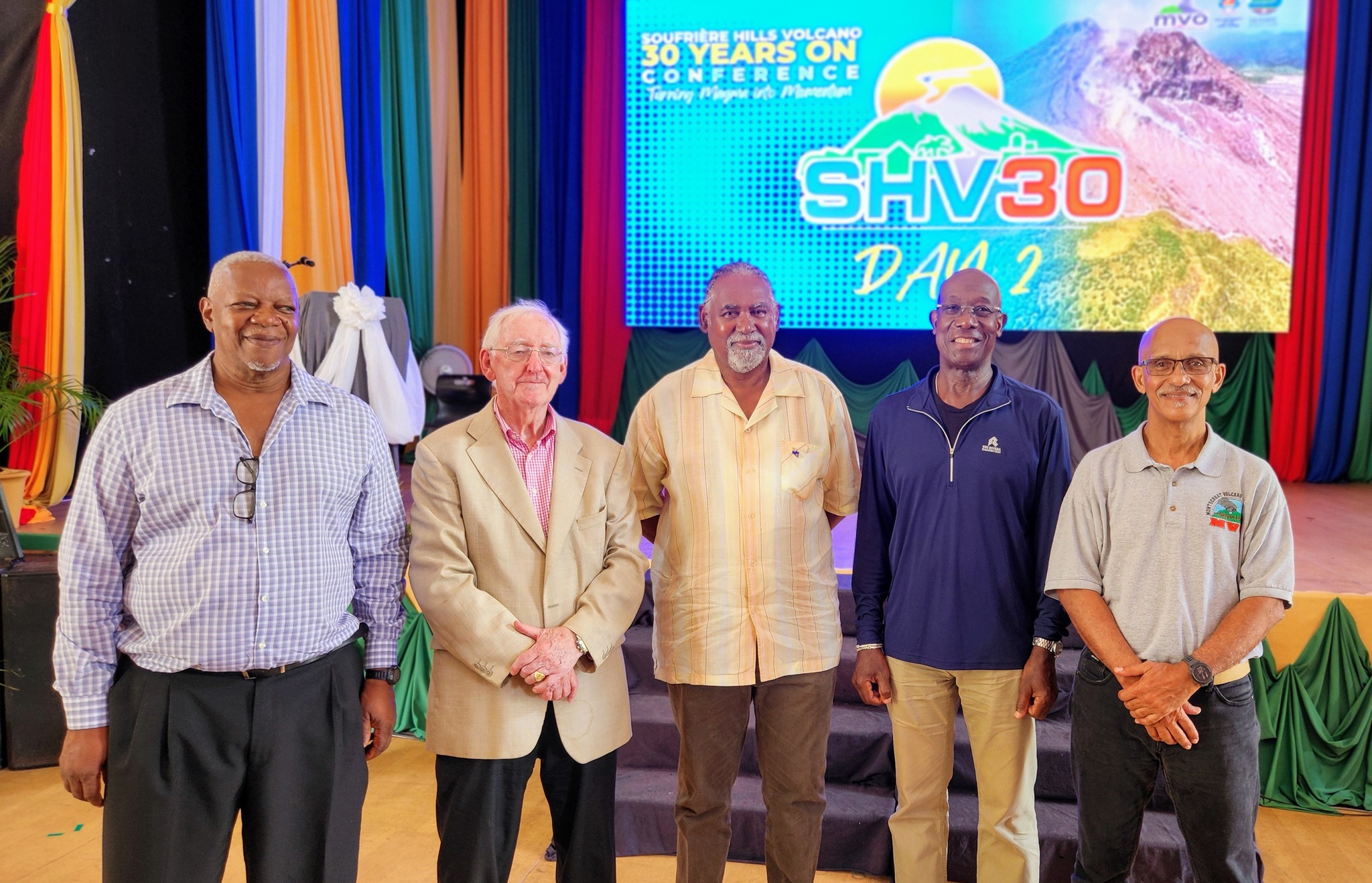
Former Governor Frank Savage and Premier Reuben T Meade took the stage together on Tuesday morning at the Montserrat Cultural Centre, offering rare, unscripted insights into the most turbulent chapter in the island’s modern history. The session, part of the ongoing SHV30 conference commemorating the start of the Soufrière Hills Volcano eruptions in 1995, marked the first time the two leaders publicly reflected together on the early crisis response that reshaped Montserrat forever.
“This is my tenth visit back to Montserrat, and it really does feel like coming home,” said Savage, who served as Governor from 1993 to 1997. He recalled arriving, just as Montserrat was emerging from the devastation of Hurricane Hugo. By 1995, the island was regaining momentum. “Plymouth looked magnificent. The economy was at takeoff point. Then came the cruelty of a volcano, something long known but never truly feared.”
Savage described how the early warning systems at the time offered little indication of what was to come. “There were virtually no precursors. When the eruption began, Montserrat had just finished rebuilding, but disaster preparedness had taken a back seat. We were focused on recovery from Hugo, not what lay beneath Soufrière Hills.”
“The Montserrat story is a great success story, a success for the people, who are among the most resilient I’ve ever come across.”
He and Meade, then Chief Minister, quickly became the island’s political anchors amid escalating scientific uncertainty. “We didn’t know what to expect. We weren’t scientists,” Meade admitted. “So every night, Frank and I went on the radio to speak to the population. We translated technical briefings into reassurance. At one stage, I thought the people were tired of us. We stopped the broadcasts until someone called me at midnight to say his wife couldn’t sleep without hearing our updates,” Meade said. “That’s when we realised just how important it was.”
Savage recounted the establishment of a new Emergency Operations Centre (EOC), built and equipped with UK funding just months before the eruption. “We created a small unit in the police compound. Some thought it was a waste — it wasn’t built for volcanoes. But when the crisis hit, it became the heartbeat of the response.” He paid tribute to Franklyn Michael, then the head of the EOC, for shaping one of the most effective disaster management units in the region.
The EOC, led by Franklyn Michael, was a mix of trained personnel and volunteers. “We had a dozen people, many without formal disaster training, stepping up to coordinate shelters, logistics, communication — everything. It became a model for the Caribbean.”
Both men spoke about the complex relationship they had with the international scientific community, and the political weight of making life-or-death decisions based on evolving, and sometimes conflicting, expert advice. “We were learning scientific language on the fly,” said Savage. “You don’t expect to need to understand pyroclastic flows or lahar paths overnight. But we had no choice.”
Meade spoke of the tense discussions with international scientists. “They didn’t always agree. Some wanted to leave. One night we got a call — scientists said they were catching the next flight out. That would have been catastrophic for public confidence.”
Savage intervened. “We held a 2 a.m. session to talk them down. It was an emotional debate. In the end, the team stayed — on the condition that the monitoring station be moved further north for safety. That’s how we ended up with the MVO at its current location.”
Both leaders acknowledged the cultural resistance to evacuation. “You couldn’t force people to leave. Many were in their 70s and 80s. Their homes were all they knew,” said Savage. “We opened shelters in the north on the first night. Some refused to go.”
“We took the American advice seriously — you must persuade, not force,” Meade added. “We didn’t have the troops or resources to hold people back. So we talked to them, one by one, every day. Sometimes they still went back.”
Meade shared personal moments of the disruption. “My own house had 18 people living in it. Families were in churches, schools, tents. It wasn’t easy. Then, in the 1996 election, we lost. The opposition said we didn’t prepare well enough. That’s politics.”
After leaving office, Meade entered the construction sector to help rebuild. “I knew nothing about building,” he joked. “But we got to work. Later, back in office, we focused on permanent infrastructure: government buildings, the new radio station, restaurants, roads — even the Viewpoint Hotel, where the MVO temporarily operated.”
Both men stressed that Montserrat’s volcanic history should not be defined by destruction alone. “The volcano gave us pain, yes,” Meade said. “But it also gave us sand, aggregate, geothermal potential, and a unique story to tell the world. It’s time we start seeing it that way.”
Savage agreed. “I’ve worked in disaster mitigation across the Commonwealth. What Montserrat achieved — with limited resources and under immense pressure — is remarkable. It should be studied, replicated, and remembered.”
The shared respect between the two leaders was evident, as was their belief in Montserrat’s ability to turn tragedy into transformation. “We must stop seeing the volcano as something tragic and instead look at the opportunities it can provide,” Meade said, pointing to current projects involving geothermal energy and tourism development tied to the island’s unique geological landscape.
Former Prime Minister of Trinidad & Tobago Dr Keith Rowley, a volcanologist and former member of the UWI Seismic Research Centre team, was also in attendance. He offered sharp reminders of how close Montserrat came to even greater tragedy, and urged regional leaders to stop deferring disaster preparedness.
Rowley described the island’s near-miss with catastrophic loss. “There were schoolchildren in Cork Hill on the day of a pyroclastic surge. Had that event unfolded just hours differently, it would have been unspeakable. There are other potential disasters within this region for which we are hopelessly unprepared, because we believe that the volcanoes either would give us enough notice or, worse, it’s not gonna happen on my watch.”
Discover more from Discover Montserrat
Subscribe to get the latest posts sent to your email.