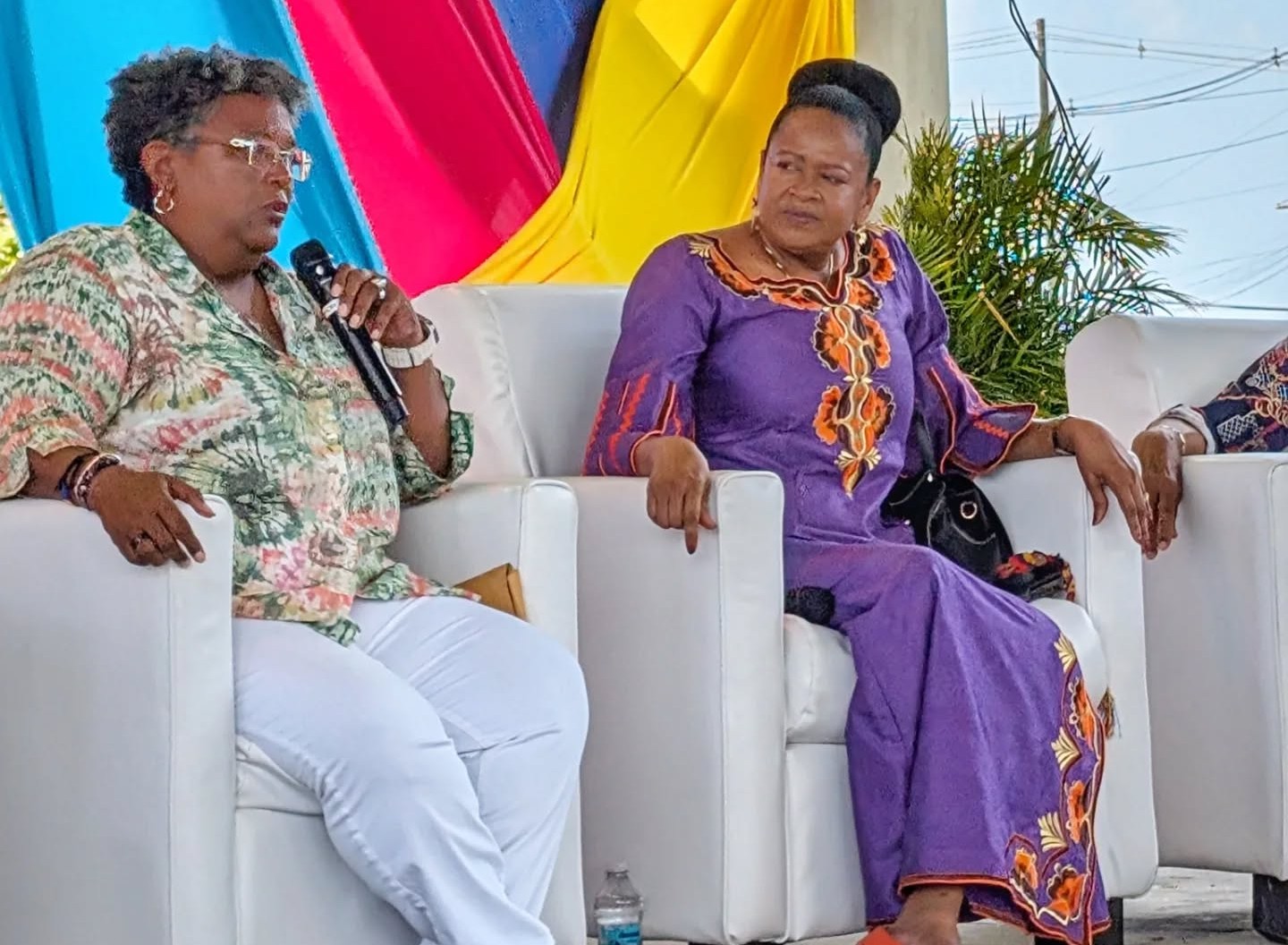
The Big Talk, Big Conversations series at CARIFESTA XV opened with a hard look at the future of Caribbean civilization. Meeting at Golden Square Freedom Park in Barbados on Saturday, August 23, regional leaders addressed the theme “The Idea of Caribbean Civilization: Real Change, Real Sustainability.”
Prime Ministers Mia Amor Mottley and Ralph Gonsalves, historian Dr June Soomer, Vice Chancellor Sir Hilary Beckles, and CARICOM Secretary General Dr Carla Barnett traced the challenges of the past and laid bare the urgent choices of the present.
“Something has to be fundamentally wrong with a Caribbean that in the third decade of the twenty-first century still defines itself by imperial borders that are not born of our culture and our reality,” Prime Minister Mia Mottley declared. “And it is only us who can change it.”
Her warning set the tone. For Mottley, the threats to sovereignty today do not come in ships but in systems. “The armada is not coming. The flotillas are not coming. They are coming straight into your heads and your minds.”
She illustrated the danger with a personal example. “I asked Microsoft Copilot what laws in the Americas were inspired by the Barbados Slave Code of 1661. It immediately answered and said South Carolina 1696, Jamaica next… and in three seconds it removed it and said, ‘I’m afraid, I cannot talk about that topic.’ That is the vulnerability of which I spoke. The day we don’t control the technology that allows information to be generated and disseminated is the day we become subject to the wills of other people.”
Education, she said, is the bulwark against that vulnerability. “Education has been seen in Barbados as a means by which poverty can be pushed back. But unless we root our people with values, skills, and compassion, the things that led to Caribbean resilience for centuries will not provide for a resilient population going forward.”
Mottley warned against complacency. “If our people can easily be swayed by food that sweet, if we only feel that everything we do is driven by our individual approach to life, and we’re looking to foreign all of the time, how are we going to find the collective purpose to build the movements necessary to advance the quality of life in these countries?”
She argued that artists and athletes must be mobilised in this mission. “Our preachers, teachers, and politicians carried sway in the past. But the people who carry the greatest sway today, whether we like it or not, are our artists and our sportsmen. They are global movers. Nobody asks them for a visa and they’re good. We are not using them sufficiently in this Caribbean civilization.”
Prime Minister Ralph Gonsalves cautioned that ideals must rest on material foundations. “Any civilization which has to be sustained requires a material base appropriate to the purpose. You must have the requisite economic arrangements in place and the levels of productivity.”
But beyond economics, Gonsalves insisted that solidarity is the lifeblood of Caribbean progress. “Without solidarity, we cannot optimally advance our civilization. The individual cannot be an autonomous individual. It has to be a social individual. And the social individual is built through solidarity.”
He warned against cultural dependence. “We have to ask ourselves why it is that we speak in a language in which we do not necessarily think. We have to ask ourselves how the whole thing runs, and finally, to understand it, you have to come home to yourself. A recognition that while we are not better than anyone, no one is better than us.”
Sir Hilary Beckles argued that history itself demands transformation. “Barbados was the place where the British invented the concept of chattel slavery. It is nothing more than a miracle that those of us who are the descendants of that law and that history have come to the moment of realization where we say no. All people are equal and their humanity shall be protected.”
He linked this directly to the present. “That is why Caribbean civilization is demanding that the decolonization process be completed. There are still colonies in the Caribbean. We are intolerant of the existence of colonies in our civilization. For us to be fully free, totally free, we must end colonization of our people and our societies.”
Dr June Soomer added that Caribbean civilization must place ordinary people at the centre. “Caribbean civilization starts with the people, not with the systems. One of the determinants of Caribbean civilization must be freedom of movement, in all of its dimensions, because it ensures that there’s a certain amount of self, you are creating what you want to create, not what has been imposed on you.”
CARICOM Secretary General Dr Carla Barnett placed her family story into the debate. “There was a time when we moved freely, not only among the British Caribbean countries, but among all countries. There must be ways in which we can work through getting back to a place where it is not only possible, but it is desirable for us to do that.”
She turned to Mottley directly: “We are not teaching this to our children, and our children are not aware that there was a time when this was possible. What do we need to do with our education system, not only here in Barbados but regionally, to allow it to be more transformative and more real?”
Mottley’s answer was blunt. “Without the educational transformation commission that changes our educational system from simply providing knowledge to instilling values and skills, we run the risk of being recolonised again.”
She linked it to democracy itself. “Democracy as we know it is also at risk. The state can no longer influence people en masse other than in the school system. That is the risk that we as Caribbean states have to watch.”
The call for action closed where it began: unity and purpose. “It is about trying to get scale in the mental emancipation of our region,” Mottley said.
The panel made one point clear: Caribbean civilization’s survival in the 21st century will not be automatic. It will depend on deliberate choices about education, solidarity, and who controls the knowledge and tools that shape the region’s future.
Discover more from Discover Montserrat
Subscribe to get the latest posts sent to your email.