
The Atlantic Hurricane Season officially began on June 1 and runs through November 30.
For many residents, the start of hurricane season raises the same questions every year. Will this be a busy season? Is Montserrat at risk? Should I be worried?
The short answer is yes, you should pay attention. But not necessarily because forecasters expect a particularly active season.
The reality is that for islands like Montserrat, it only takes one storm.
A Quieter Season is Expected
This year, the United States National Oceanic and Atmospheric Administration (NOAA) is forecasting a 55 percent chance of a below-average hurricane season.
Forecasters predict between eight and 14 named storms, with three to six expected to become hurricanes and one to three strengthening into major hurricanes of Category 3 or higher.
That is slightly below the long-term average of 14 named storms, seven hurricanes and three major hurricanes.
The main reason for the lower forecast is the expected development of El Niño conditions in the Pacific Ocean.
What is El Niño?
El Niño is a naturally occurring climate pattern that influences weather around the world.
One of its effects in the Atlantic is to increase upper-level winds, known as wind shear. Strong wind shear can disrupt developing tropical systems before they have a chance to strengthen into hurricanes.
That does not mean hurricanes cannot form.
In fact, some of the strongest storms in history have occurred during El Niño years. It simply means conditions are generally less favourable for hurricane development.
As disaster officials repeatedly reminded attendees at last week’s Annual Hurricane Conference, seasonal forecasts are not predictions of where storms will go.
They only indicate how many storms are likely to form across the Atlantic basin.
Why Montserrat Still Needs to Prepare
One statistic presented during the conference deserves particular attention.
Researchers at Colorado State University estimate there is a 35 percent chance that at least one major hurricane could track through the Caribbean region this year.
Montserrat sits directly within that zone.
History also provides a reminder that quieter seasons can still produce devastating storms.
In 1997 and 2015, both considered below-average seasons influenced by El Niño conditions, major hurricanes still formed and caused significant damage across the region.
For Montserrat, Hurricane Hugo remains the defining example.
When Hugo struck in September 1989, it became the most destructive hurricane in the island’s recorded history, causing widespread devastation and fundamentally changing how disaster preparedness is approached today.
The Most Potentially Dangerous Months Are Ahead
Although hurricane season has begun, historically the most active period is still several weeks away.
The season typically peaks between mid-August and early October, with September often producing the highest level of activity.
That means the weeks ahead provide an important window for preparation.
Officials are encouraging residents to review emergency plans, inspect roofs and gutters, secure important documents and gradually build emergency supplies rather than waiting until a storm is approaching.
More Than Hurricanes
One of the most important messages from this year’s conference was that hurricanes are not the only threat.
Montserrat’s steep terrain and volcanic landscape mean that heavy rainfall alone can create serious problems.
Last year’s flooding demonstrated how intense rain can damage roads, overwhelm drainage systems and disrupt communities even without a named storm.
Other hazards that can occur during the hurricane season include landslides, coastal flooding, storm surge, rockfalls, rough seas and prolonged dry periods that increase wildfire risk.
In other words, residents should pay attention to weather advisories even when no hurricane is in the forecast.
Support Beyond Montserrat
Montserrat does not face hurricane season alone.
The island forms part of a wider regional disaster response network coordinated through the Caribbean Disaster Emergency Management Agency (CDEMA) and receives support from the United Kingdom during major emergencies.
The UK traditionally assigns Royal Navy vessels to the Caribbean during hurricane season, providing humanitarian assistance, engineering support, emergency supplies and transport capabilities when required.
Last year, HMS Trent visited Montserrat as part of those regional preparedness efforts.
Governor Harriet Cross also confirmed that the UK Ministry of Defence has reaffirmed its commitment to supporting the Overseas Territories during the 2026 season.
In addition to the ships themselves, regional and UK partners regularly participate in disaster preparedness exercises and planning activities designed to ensure assistance can be delivered quickly when needed.
The 2026 Storm Names
Should storms develop this year, they will be named from the following list: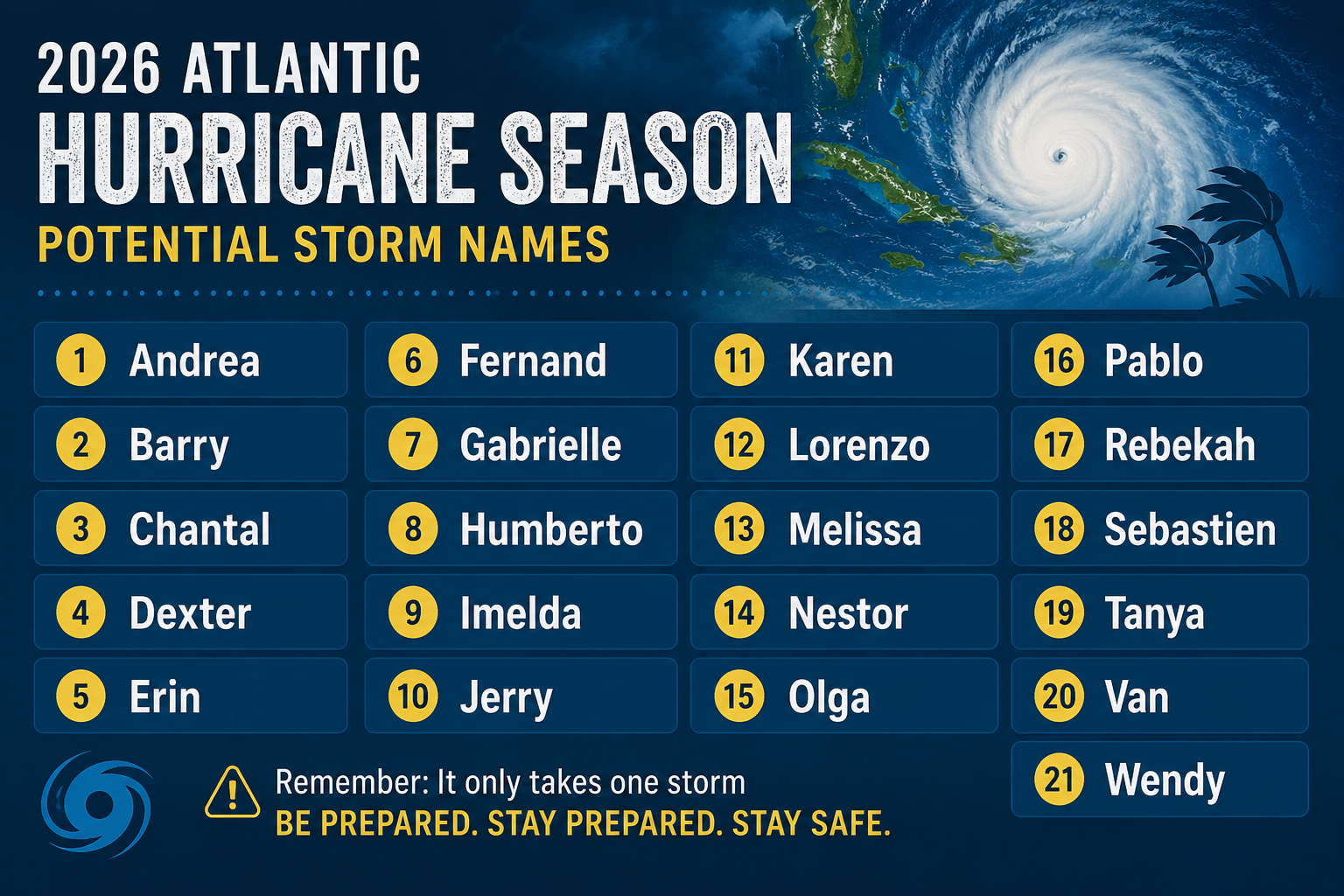
Not every name will be used. In some years only a handful of storms form. In others, the entire list can be exhausted.
The Bottom Line
The forecast suggests 2026 could be a quieter hurricane season than average.
That is welcome news.
But hurricane forecasts are not guarantees.
A season with eight storms only becomes important to Montserrat if one of those eight storms comes here.
That is why emergency officials continue to repeat the same message year after year:
Be Prepared. Stay Prepared. It Only Takes One.
Discover more from Discover Montserrat
Subscribe to get the latest posts sent to your email.