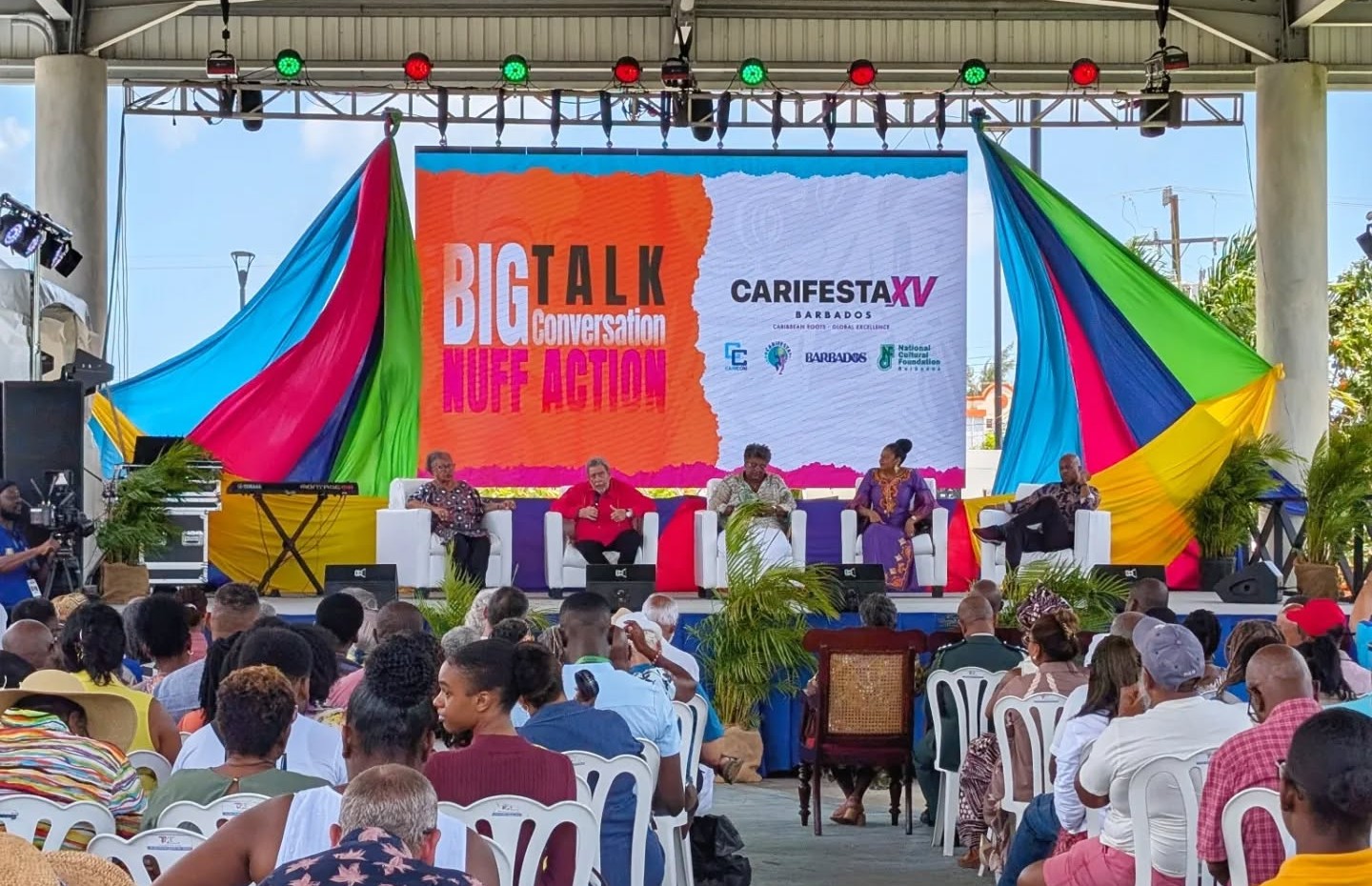
The first in the Big Talk, Big Conversations series at CARIFESTA XV set the stage for a profound reflection on Caribbean identity. Held at Golden Square Freedom Park in Barbados on Saturday, August 23, the panel explored “The Idea of Caribbean Civilization: Real Change, Real Sustainability.” Featuring Prime Ministers Mia Amor Mottley and Ralph Gonsalves, historian Dr June Soomer, Vice Chancellor Sir Hilary Beckles, and moderated by CARICOM Secretary General Dr Carla Barnett, the conversation traced how the Caribbean’s painful history forged a civilization rooted in struggle, resistance, and survival.
“Civilization has visible sides and invisible sides,” said Prime Minister Ralph Gonsalves of St Vincent and the Grenadines. “The visible ones are fairly easy to identify. But it’s the invisible side, that which reflects our customs, our forms of behavior, the genius of our people, that is important for us to tap.”
For Gonsalves, Caribbean civilization is not about conquest or empire. “It is that genius, which is resident in our people, which is important for us to tap. Civilization doesn’t have to be one which is associated with Imperium. It has come to be acknowledged that there is something distinct called island-sea civilization.”
Prime Minister Gonsalves continued to say “We have fashioned a civilization of a very special kind in this Caribbean. A civilization of high quality, where we do have metaphorically a symphony. We are the songs of the indigenous people. We are the rhythm of Africa. We are the melody of Europe. We are the courts of Asia, and we are the lyrics of the Caribbean. And like all symphonies, we do have dissonance, and we address those dissonances, either through the formal institutions or through the informal ones to create societies of an amazing nature.”
Sir Hilary Beckles drew the audience deep into Barbados’ historical role. “Barbados was the first slave society in our region. This is where the British invented the concept of chattel slavery and built that model into Barbados. Barbados then became the home of the first chattel slave society in this hemisphere, and it is from Barbados that that model was exported across the hemisphere.”
He added, “Barbados therefore became the first society in our hemisphere where African people were in the majority. This is the first majority African society in the hemisphere.”
Africans themselves named Barbados in the starkest of terms. “We have on record a statement as early as 1694,” Beckles said. “An African about to be boarded on a slave ship said: ‘Barbados we know is a place worse than hell.’ That is the first black definition of Barbados.”
Yet within that oppression lay the seeds of freedom. “The people of this island decided that since Barbados was the most oppressive society in the world, it will become in our charge, in our hands, the freest society in the world. Freedom is now the most important value within Barbadian society,” Beckles insisted.
Historian Dr June Soomer pushed the lens wider, emphasising that people, not systems, define Caribbean civilization. “Caribbean civilization starts with the people, not with the systems, not with the policies, it starts with the people,” she said.
Her view was shaped by personal history. “As a young child, I came to understand Caribbean civilization as something that gave us a certain amount of freedom, freedom of movement. When enslaved people ran away from plantations into maroon societies, they tried to recreate the civilizations they knew. One of the determinants of Caribbean civilization must be freedom of movement, in all of its dimensions.”
Dr Soomer expressed her frustration that within CARICOM, some island states have been deemed less than us by their associate member status. “What is an associate member? They are members, and I am saying that it is us in the independent countries, who must recognize that we cannot have a Caribbean civilization with people who are less than us. We are creating equality and equity we have taken a long time to remove the chains that bound us.”
She challenged the region to complete decolonization. “Barbados is the example for all of us because it is now a republic. My challenge is to Barbados to ensure that the rest of the flags, the Dutch, the French, are removed from the region.”
Sir Hilary Beckles shared his dismay at the separation that still remains across the region. “They will not drive Mia Mottley out of office because somehow she has the goodwill of the entire Caribbean and that final struggle is to let us complete the decolonization process. There are still colonies in the Caribbean and we are intolerant of the existence of colonies and our Caribbean civilization. There are still islands that are pledging their allegiance to foreign powers. Recently, the students in one of those colonies was told by their government, go to England and get your education because it is cheaper for you to go to England thank to go to UWI, which is your university. But that is colonization. I feel offended when I arrive in Martinique to meet my colleagues and I see a sign at the airport which says, welcome to France. I personally find that offensive. So we have to end this conversation because the Caribbean was where European colonization started. And the process is not complete for us to be fully free. We must end colonization of our people and our societies. And that is the battleground that is left.”
An interesting fact shared by the UWI Vice Chancellor was that “Barbados became the first society in this hemisphere where women outnumbered men. From 1720 until today, women have been the majority in this island, not surprising we have a female prime minister and a female president. It’s a reflection of that history that this has long been a woman society and the history moves forward to give expression to that issue.”
Beckles concluded by reminding the audience of the Caribbean’s mission. “It is nothing more than a miracle that those of us who are the descendants of that law and that history have come to the moment of realization where we say no. All people are equal and their humanity shall be protected.”
The conversation revealed that Caribbean civilization is not defined by monuments or empires but by endurance, survival, and the people’s insistence on freedom. As Gonsalves summed up, it is “a symphony, we are the songs of the indigenous people, the rhythm of Africa, the melody of Europe, the chords of Asia, and the home lyrics of the Caribbean.”
Discover more from Discover Montserrat
Subscribe to get the latest posts sent to your email.