Montserrat must rethink how it educates its children if it hopes to become a society of creators rather than followers, according to educator and former deputy premier, Dr Samuel Joseph.
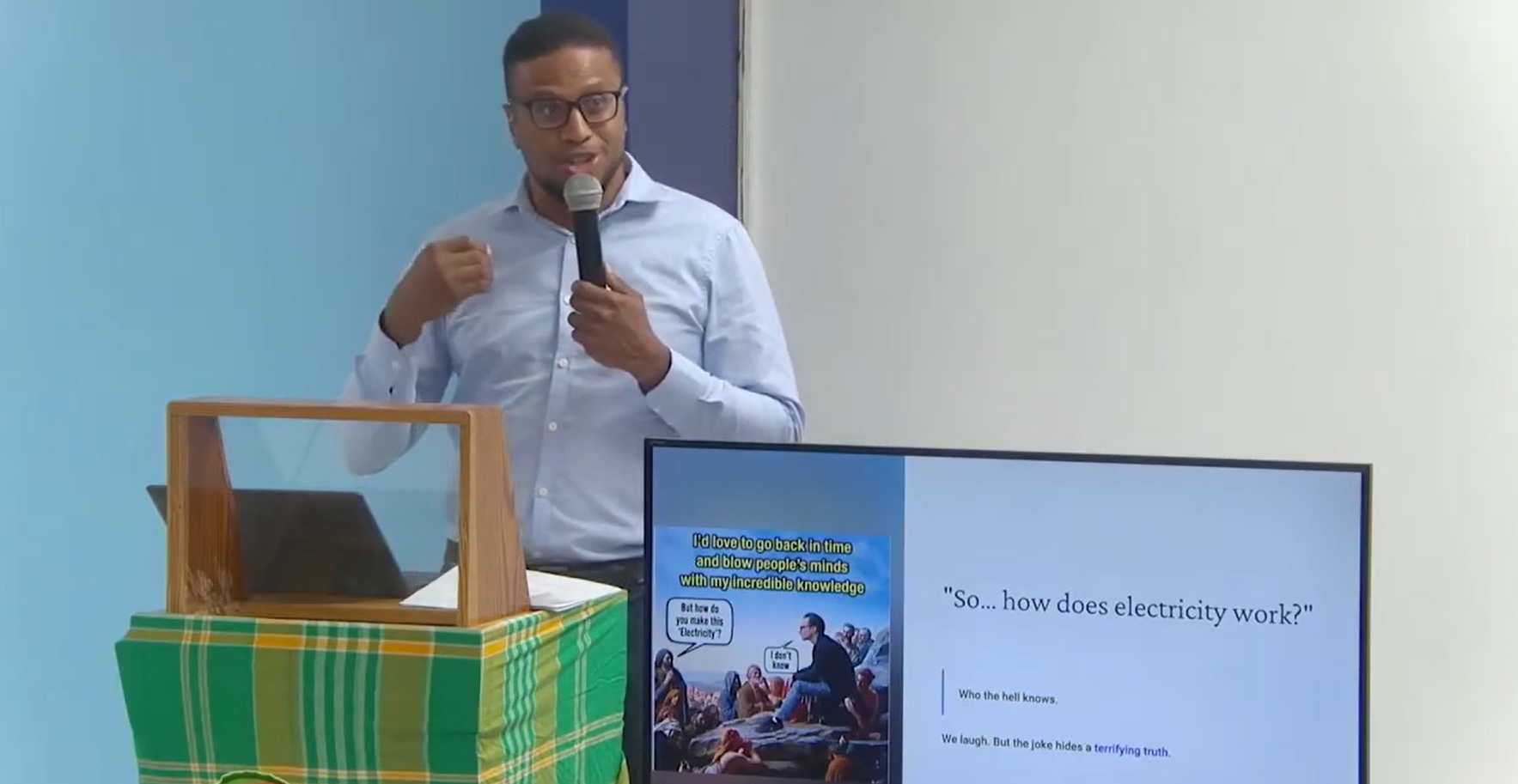
Joseph delivered the annual St Patrick’s Lecture on Wednesday, March 11 at the Public Library in Brades under the theme The Magic Trap: Why Montserrat Must Be Architects, Not Followers. The lecture explored how education, technology and cultural mindset shape the island’s ability to determine its own future.
The event was opened by Dr Sheron Burns, head of the University of the West Indies Global Campus in Montserrat, who introduced Joseph as an educator committed to strengthening early mathematical thinking and helping children develop positive relationships with mathematics from their earliest years.
Joseph began his presentation by reflecting on how modern societies interact with technology.
He suggested that if people living today were transported two hundred years into the past and asked to explain how modern inventions work, most would struggle.
“If you’re honest you will realise that 99 percent of us in here have no idea how the world works in which we are living,” he said. “You’re just a passenger on a plane flying with somebody piloting it.”
Earlier generations, he noted, often understood the tools they used daily. Farmers could explain how their ploughs worked, fishermen knew their boats intimately, and craftspeople built many of their own tools.
In contrast, people today interact with complex systems that appear almost magical.
“We flip a switch and light comes on,” Joseph said, describing how people routinely use technology without understanding the processes behind it.
He described this as the “magic trap”, a condition where society becomes dependent on systems it does not understand.
That dependency, he warned, can reduce a society’s ability to shape its own future.
“Freedom is not being sitting in a plane and putting on your seatbelt,” Joseph said. “Freedom is sitting in the cockpit and directing the plane.”
Joseph connected this idea to the significance of St Patrick’s celebrations in Montserrat, which commemorate the island’s slave uprising and the broader struggle for freedom.
He argued that freedom was never simply about removing chains but about gaining the right to make decisions and direct one’s own path.
“If you’re still in a situation in which we are not choosing and we are not directing our future,” he said, “we are still in bondage.”
Joseph suggested that while physical slavery has ended, modern societies face new forms of control. He described these as economic dependency, mental compliance and algorithmic influence.
Economic systems across the Caribbean, he said, often operate within frameworks that the region did not design and does not control.
Mental slavery appears when people believe success comes simply from following instructions rather than thinking independently.
The newest form, which he called algorithmic slavery, arises from the way digital platforms increasingly shape how people think and what information they consume.
“If a machine decides what you see, if a machine decides how you feel, if a machine decides how you respond, who is really in control of your mind?” Joseph asked.
He argued that the education system unintentionally reinforces this problem by rewarding compliance rather than curiosity.
“The child that follows instructions the best,” he said, “that child is a good student.”
Students who ask too many questions, meanwhile, are often seen as disruptive.
The result, Joseph said, is a society trained to reproduce information rather than create new ideas.
“We are producing hard drives and not processors,” he said.
This approach, he warned, is especially problematic in an age of artificial intelligence, where machines can store and retrieve information far more efficiently than humans.
“The world does not need more people to store facts,” Joseph said. “Machines can already do that.”
Instead, he argued that education must focus on reasoning, curiosity and problem-solving.
“Getting an answer is not a skill,” he said. “The skill is knowing what question to ask.”
Joseph concluded by urging Montserrat to pursue what he described as cognitive sovereignty — the ability for individuals and societies to think independently and direct the technologies they use.
As a small island, he said, Montserrat has the opportunity to rethink outdated systems rather than simply replicate them.
“We don’t want our children to be asking the machines for answers,” he said. “We want them to know what questions to ask.”
The future, Joseph said, is not something that simply arrives.
“The future does not arrive. We create the future.”
And whether Montserrat becomes a creator of that future or simply adapts to one shaped elsewhere will depend largely on how it educates its children today.
Discover more from Discover Montserrat
Subscribe to get the latest posts sent to your email.