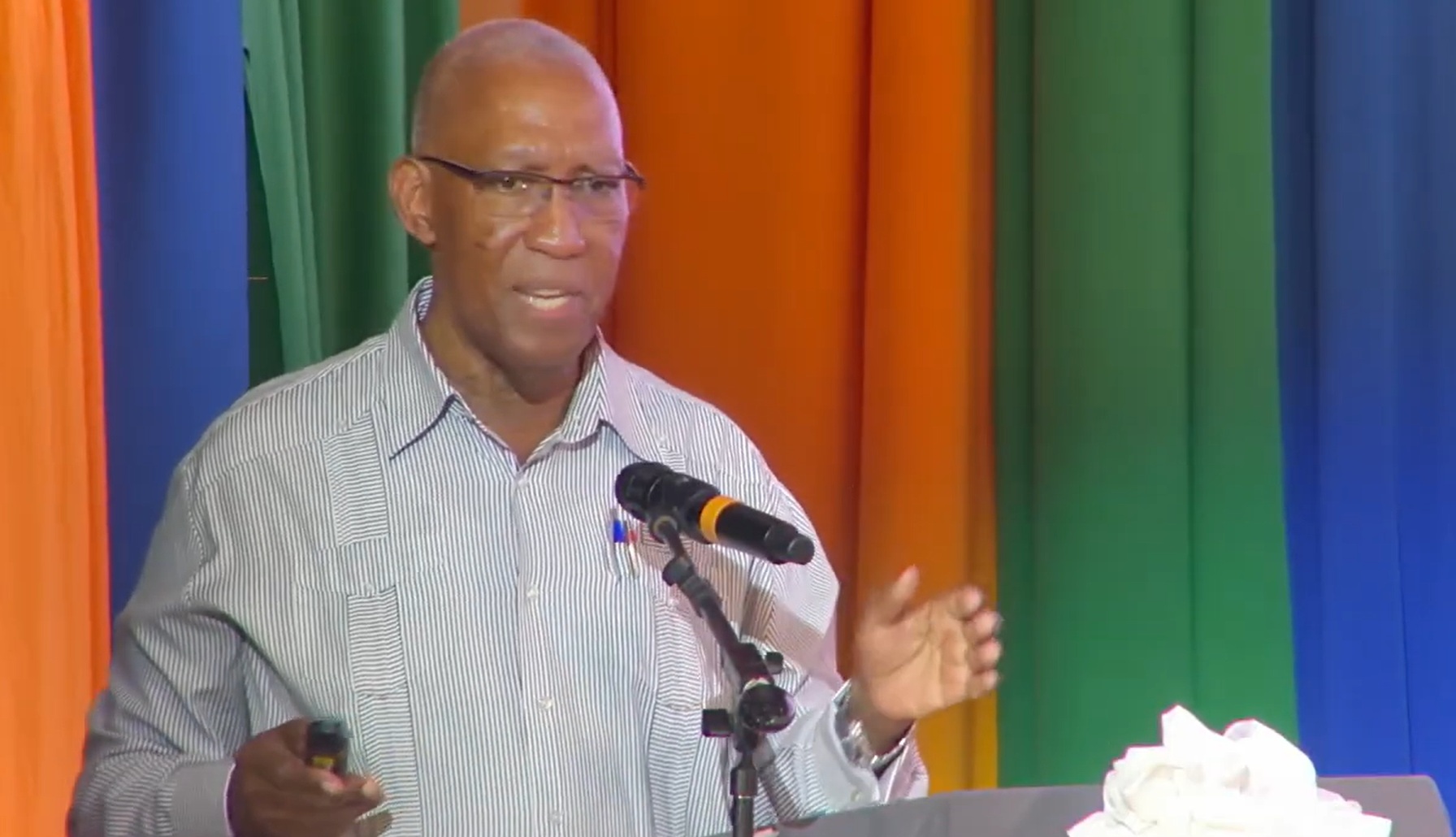
Franklyn Michael, who led Montserrat’s Emergency Operations Centre during the height of the volcanic crisis, delivered a powerful address at the SHV30 conference on Tuesday morning, recounting the realities of disaster management under pressure and the weight of protecting an entire nation.
“There was no textbook that could prepare us for what was coming,” said Michael, who was on duty from the very first night the volcano reawakened on July 18, 1995. “When I say I was there, I mean my family was at risk, and I was at the Emergency Centre. This wasn’t theoretical. It was personal.”
Michael painted a vivid picture of the human and infrastructural toll of the eruptions. “We lost not just land, but livelihoods, generational investments, and our way of life,” he said. “There are families on this island that lost 40, 50 acres of land. That’s not some abstract concept of risk, that’s decades of sweat, inheritance, and hope turned to ash.”
The island’s population dropped from 10,000 to just 3,500 by 1998. “People ask, ‘Why didn’t they leave?’ But how do you just walk away from your home, the biggest investment of your life?” Michael asked. “You tell someone to leave their land, their house, the place where their children grew up – it’s not that easy.”
He also recounted the living conditions many faced during those years. “There was a situation where a young woman was always late for work. We later found out she was living in a house with 21 people and had to wait to use the bathroom to get her baby ready in the mornings. That was our reality.”
Despite the chaos, Michael highlighted the island’s organisational successes, including early development of a local monitoring system, high levels of inter-agency coordination, and the production of public evacuation guides. “By November 1995, we had an official evacuation guide and a residents’ guide. The National Youth Council hand-delivered a copy to every single occupied household. We weren’t just reacting, we were preparing people, one family at a time.”
He also commended women’s leadership within the EOC: “Consistently, more than 60% of the volunteers were women. Many of them are still serving in public life today.”
The psychosocial toll was enormous. “We didn’t have the luxury of professional trauma counsellors, but we were dealing with people on the brink. I remember someone who, upon hearing a helicopter, said: ‘The legions are coming to rescue me.’ That’s the level of psychological strain we faced,” Michael recalled.
He described shelters as makeshift but managed with order and compassion. “Churches, schools, even people’s homes became shelters. We drafted shelter rules with legal authority, and despite limited space, we ensured dignity was preserved.”
Michael called on the region to learn from Montserrat’s experience, particularly in integrating disaster planning into national development strategies. “Every Caribbean country should prepare for high-impact hazards. We can’t keep saying, ‘It won’t happen here.’ We said that too, until it did.”
He stressed that Montserrat’s experience must be treated as a regional resource. “We’re not going to be around forever. Those of us who were there, we carry this history not just in our memories but in the systems we built. Use us. Learn from us. Before it’s too late.”
The session, which also featured Premier Reuben T Meade and former Governor Frank Savage, was attended by former Trinidad & Tobago Prime Minister Dr Keith Rowley. Rowley, who worked in Montserrat as a volcanologist in the early eruption years, reminded the audience that “Montserrat came dangerously close to a much worse outcome,” and urged regional leaders to treat disaster readiness as a political and moral imperative.
ZJB Radio and the Government Information Unit are broadcasting SHV30’s main sessions daily on Facebook and YouTube, allowing Montserratians at home and abroad to follow this landmark event.
Discover more from Discover Montserrat
Subscribe to get the latest posts sent to your email.