
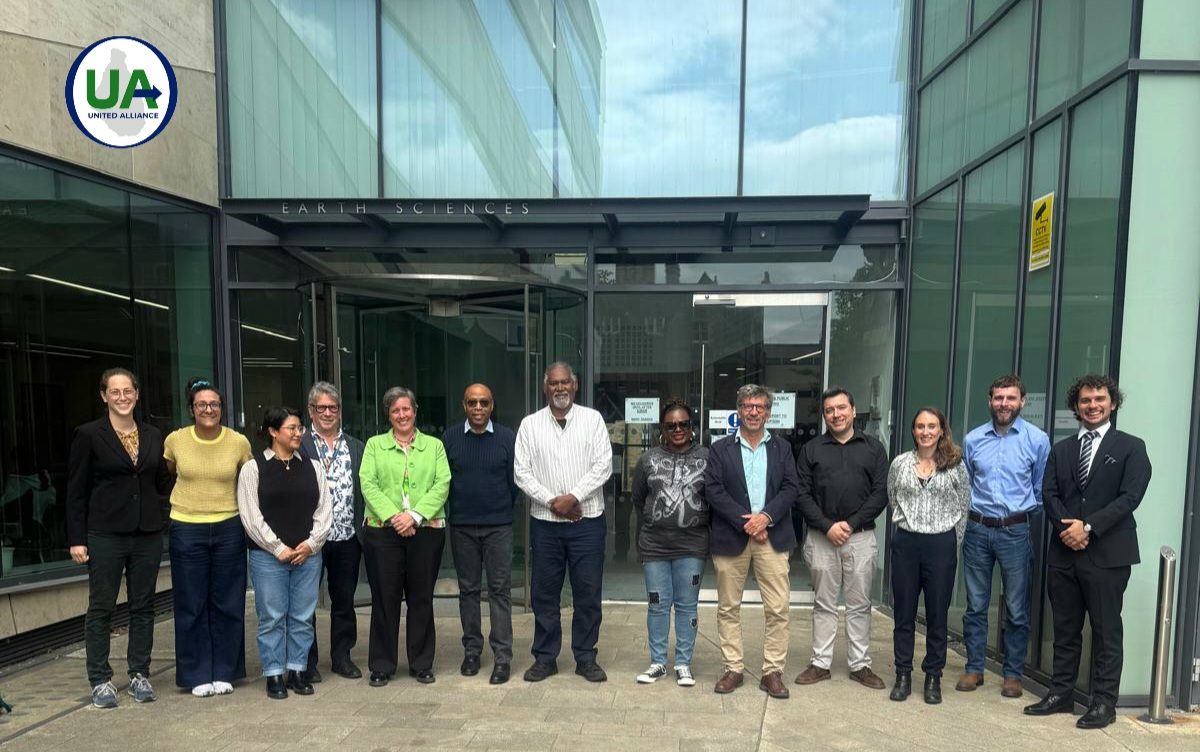
Montserrat’s Soufrière Hills Volcano, once a symbol of destruction, is now the focus of groundbreaking research that could reshape the island’s future and contribute to global sustainability efforts. In collaboration with Oxford University’s Earth Sciences Department and the Oxford Martin School’s Rethinking Natural Resources (ReSET) Programme, the Government of Montserrat is exploring how the island’s volcanic environment could provide critical materials essential for clean energy technologies.
Premier Reuben T. Meade recently visited Oxford to learn more about the ReSET Programme’s ongoing research and its potential benefits for Montserrat. “It was a pleasure meeting the ReSET team at Oxford University’s Earth Sciences Department and to experience first-hand their ground-breaking research into the Soufrière Hills Volcano,” said Premier Meade. “This visit reaffirms the value of our partnership in preparing Caribbean communities for a sustainable future.”
The island is one of 13 volcanic territories in the Eastern Caribbean, but it stands apart due to its active volcano and the potential economic value it now represents. Following the devastating 1995 eruptions that destroyed the capital city of Plymouth and displaced the majority of the population, Montserrat has focused on recovery through infrastructure development and disaster preparedness. Today, the focus is shifting from risk mitigation to resource innovation.
The new collaboration with Oxford University centres on the potential to harness geothermal energy and extract valuable critical metals such as copper, lithium, and gold from mineral-rich geofluids deep beneath the volcano. These metals are vital for the Net Zero transition, particularly in battery manufacturing, electric vehicles, and renewable energy systems.
“Volcanoes release vast amounts of critical metals like copper, lithium, and gold, metals that are vital for the Net Zero transition, use in the manufacturing of batteries and EV cars, to the generation and transmission of renewable electricity,” the release noted.
Jon Blundy, Director of the Rethinking Natural Resources programme, explained the significance of Montserrat’s potential: “We are delighted to collaborate with the Government of Montserrat to explore the economic potential of geothermal energy on the island. Our geophysical and social sciences research is ongoing. A critical next step is to flow the MON-1 and MON-2 wells to establish the chemical composition of the hot fluids that will be used for geothermal power production.”
These geofluids, hot and saline liquids trapped beneath the Earth’s surface, may offer a dual benefit: a renewable source of geothermal power and a sustainable method for extracting critical minerals. With global demand for these metals rising and conventional mining practices often linked to severe environmental and social consequences, this research could pave the way for a more responsible supply chain.
The ReSET team will continue to work closely with Montserrat’s Premier and Governor, alongside the Foreign, Commonwealth & Development Office (FCDO), the Department for Energy Security and Net Zero (DESNZ), and the island’s communities. Together, they aim to develop a framework for resilient, sustainable resource development.
Through this collaboration, Montserrat is positioning itself at the forefront of an innovative approach to clean energy and mineral sourcing, one that could turn its greatest natural threat into a global asset.
Discover more from Discover Montserrat
Subscribe to get the latest posts sent to your email.