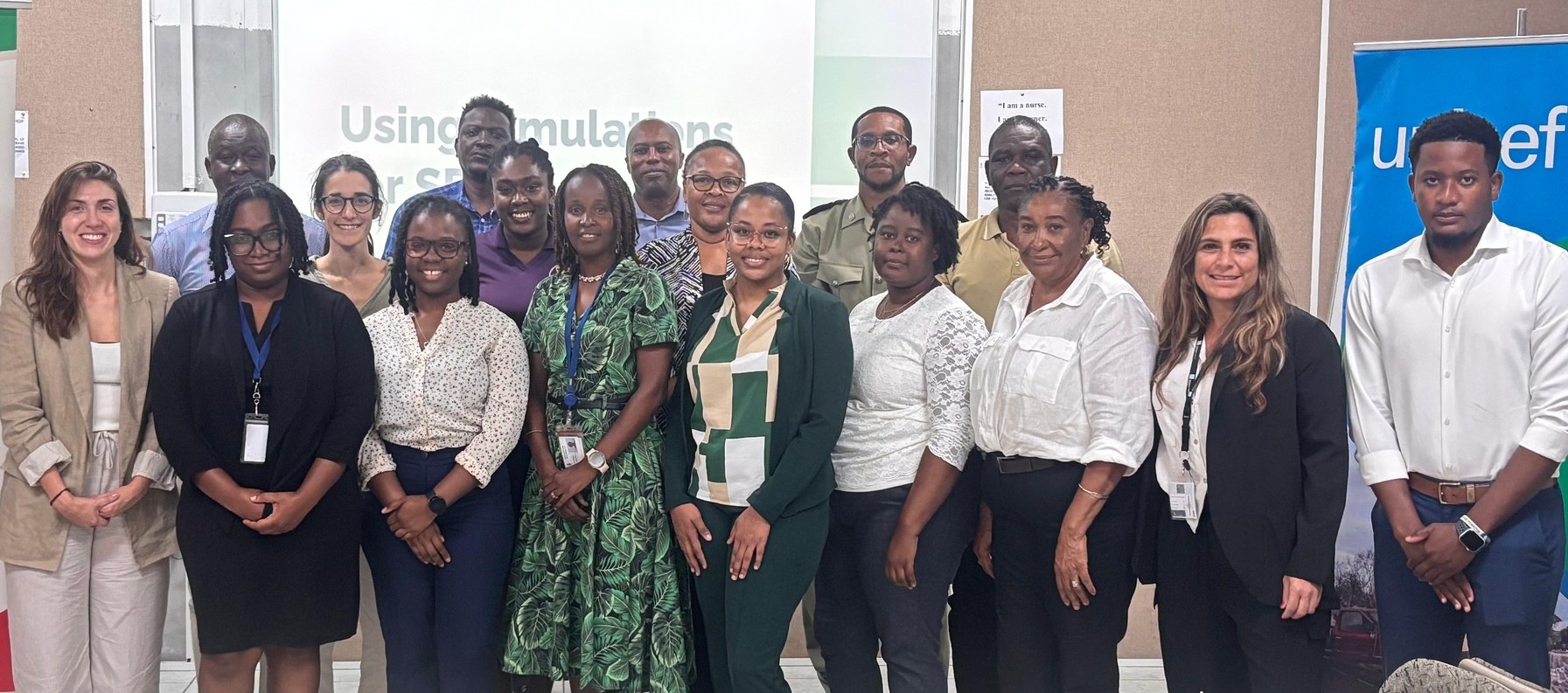
With children’s safety, wellbeing and learning at the heart of national emergency planning, Montserrat this week undertook a high-level simulation exercise to strengthen its ability to protect vulnerable families in times of crisis. The exercise tested the island’s social protection system under pressure, helping to ensure that when disasters strike, children can continue learning, access vital support, and remain safe.
Led by the Disaster Management Coordination Agency (DMCA) and the Ministry of Health and Social Services, and facilitated by the Caribbean Disaster Emergency Management Agency (CDEMA), UNICEF, and NORCAP, the simulation focused on preserving access to critical services like education during emergencies.
The scenario posed a realistic and complex challenge: a powerful hurricane followed by volcanic activity. This dual hazard tested coordination among social protection actors, emergency services, the private sector, the Ministry of Finance and Treasury, NGOs such as the Red Cross, and education stakeholders all working together to protect the most vulnerable.
“This was a tough but necessary exercise,” said one participant. “It prepared us to think beyond a single hazard and look at how our systems can function in complex emergencies.”
UNICEF’s support underscored the importance of resilient systems that prioritise children’s needs, ensuring that even in the face of multiple shocks, schools can reopen quickly, services reach families in need, and no child is left behind.
The simulation was praised as a timely investment in preparedness, building stronger coordination across sectors and helping Montserrat respond faster and more effectively to future crises.
In a region where disasters are a reality, not a possibility, this exercise marks a critical step towards safeguarding every child’s right to safety, protection and education.
Discover more from Discover Montserrat
Subscribe to get the latest posts sent to your email.