Montserrat’s underground heat was the subject of Thursday morning’s session at SHV30. Geothermal resources: from exploration to sustainable development was the theme with presentations that discussed legal considerations, the Kenya and New Zealand geothermal stories and Montserrat’s potential.
“Geothermal is not new in Montserrat,” said Dr Graham Ryan, Director of the Montserrat Volcano Observatory. “We’ve been talking about it for many decades. First, shallow wells were drilled in the late sixties. There have been several studies from … nineteen seventies to 2008. So it’s something we’ve been talking about for a long time.”
Ryan, who began working on geothermal exploration in 2009 as part of a multi-disciplinary effort, said Montserrat’s reservoir temperature estimates range from 35 to 52 megawatts in terms of electrical output.
“So there’s a simple stored heat calculation, which is basically just calculating how much heat is stored in the reservoir,” he said. “And then if you say, we’re gonna run this for thirty years, how much would it take to use all that heat?”
Using two different methods to calculate the potential output, one based on stored heat, the other on temperature modeling, he said, “When you do that, the median power output comes up to about 35 megawatts electrical… doing that, we come up with a median or best estimate of about 52 megawatts.”
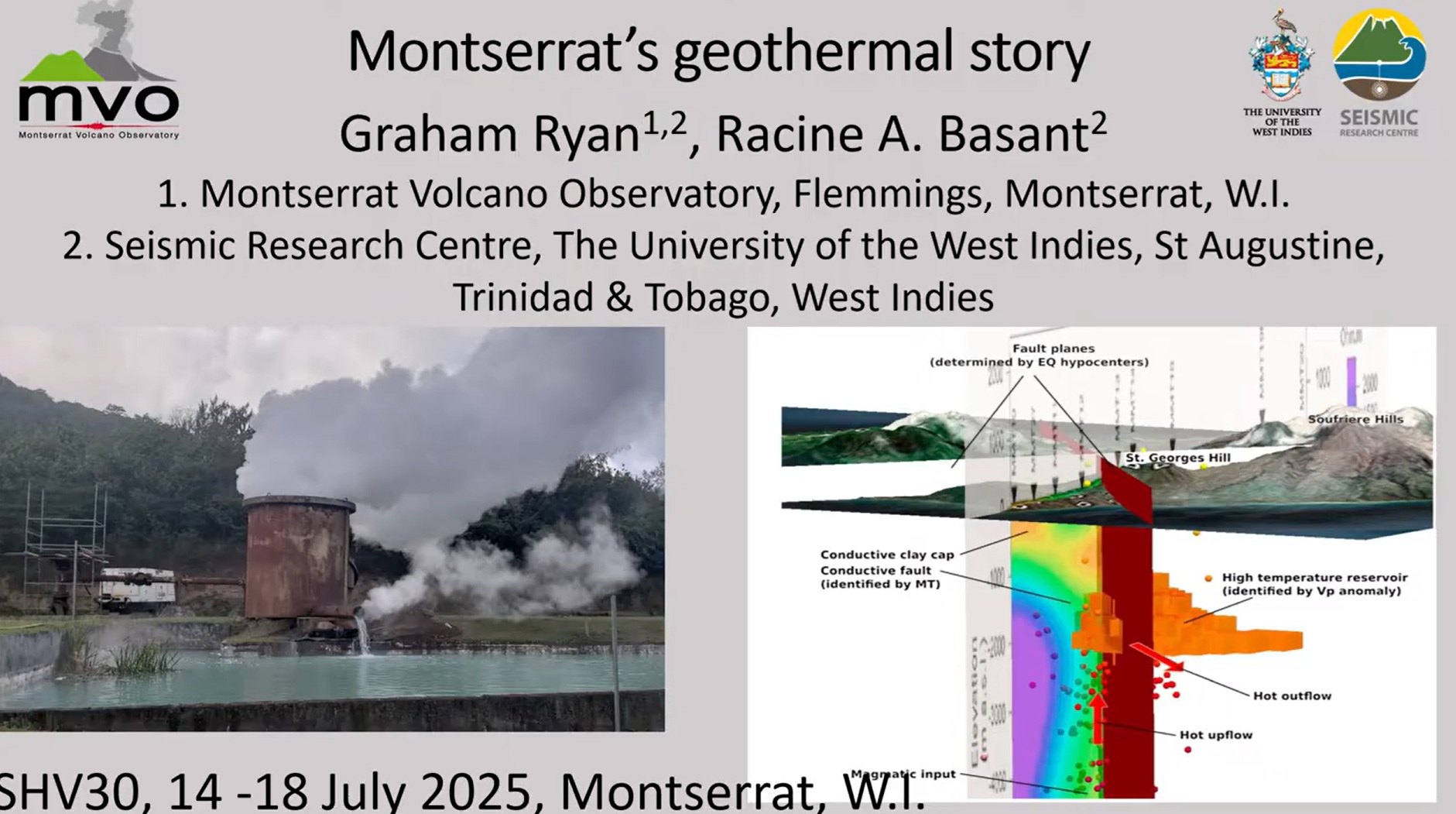
Putting that in real-world terms, Dr Ryan remarked: “You saw a little wellhead generator… that little box with steam coming out, that would meet all of Montserrat’s geothermal needs. That simple.”
Ryan’s work has been influenced by geothermal leaders in Kenya. “I have a Kenyan pedigree as well because in my previous life, I worked a lot with two Kenyan experts in geothermal exploration, Dr. Stephen Onacha and Dr. Peter Omenda. Both brilliant, hardworking and very inspiring and taught me a lot of what I’ll be presenting here today.”
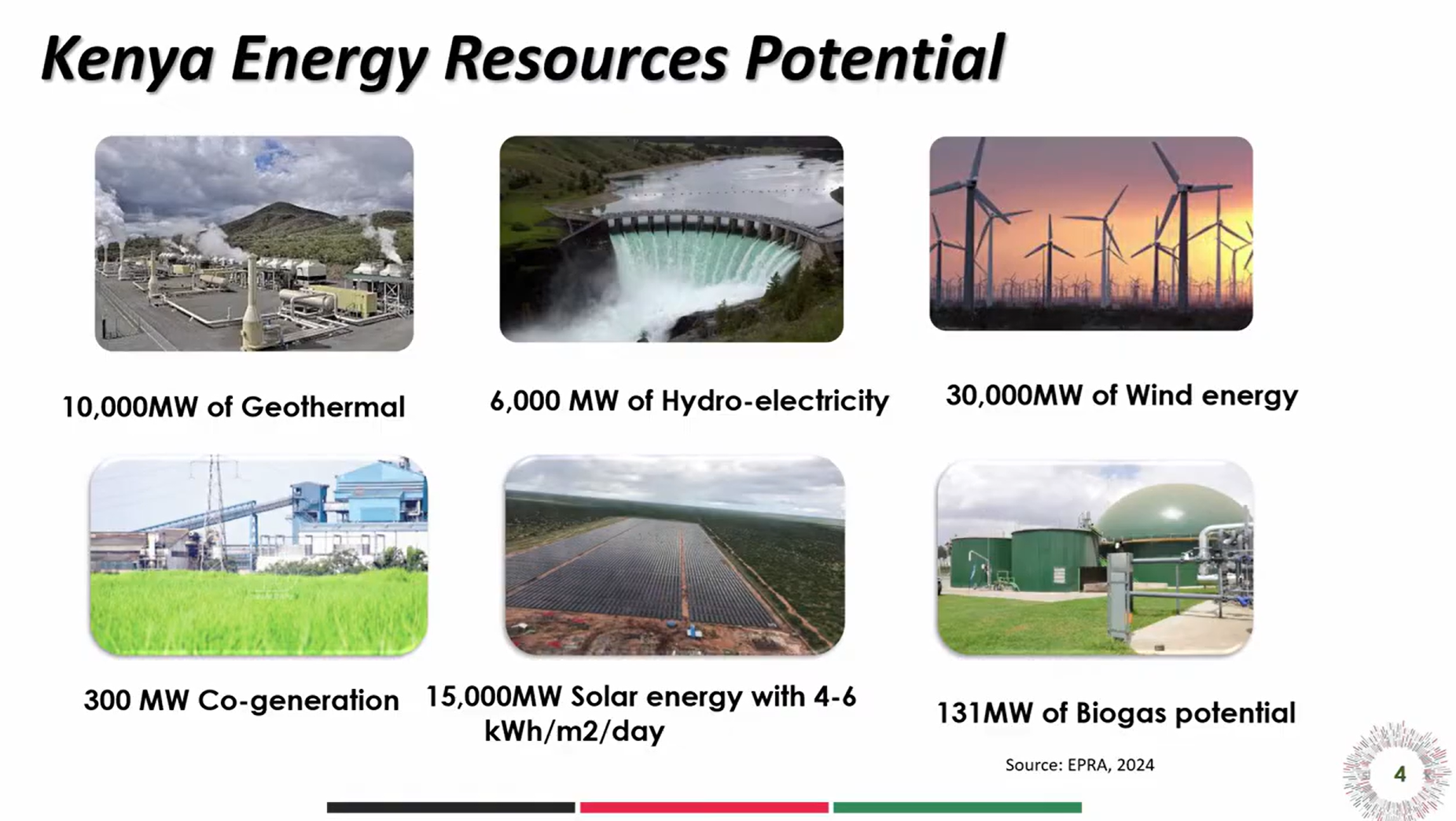
Kenya’s geothermal journey, presented via video by Dr Patrick Kariuki of Dedan Kimathi University of Technology, painted a compelling picture. “We are proud to say that Kenya is the first country in Africa to explore geothermal electricity at scale… currently giving us 950 megawatts,” said Kariuki. “It has been established that geothermal can give us 10,000 megawatts if fully exploited.”
Beyond power, Kenya is investing in “emerging opportunities in green hydrogen production” and direct uses such as heated fishponds, milk pasteurisation, and agricultural drying. “Some of them are at piloting stage and some of them are operational. Like, for example, in the case of Olkaria, it’s operational,” said Kariuki.
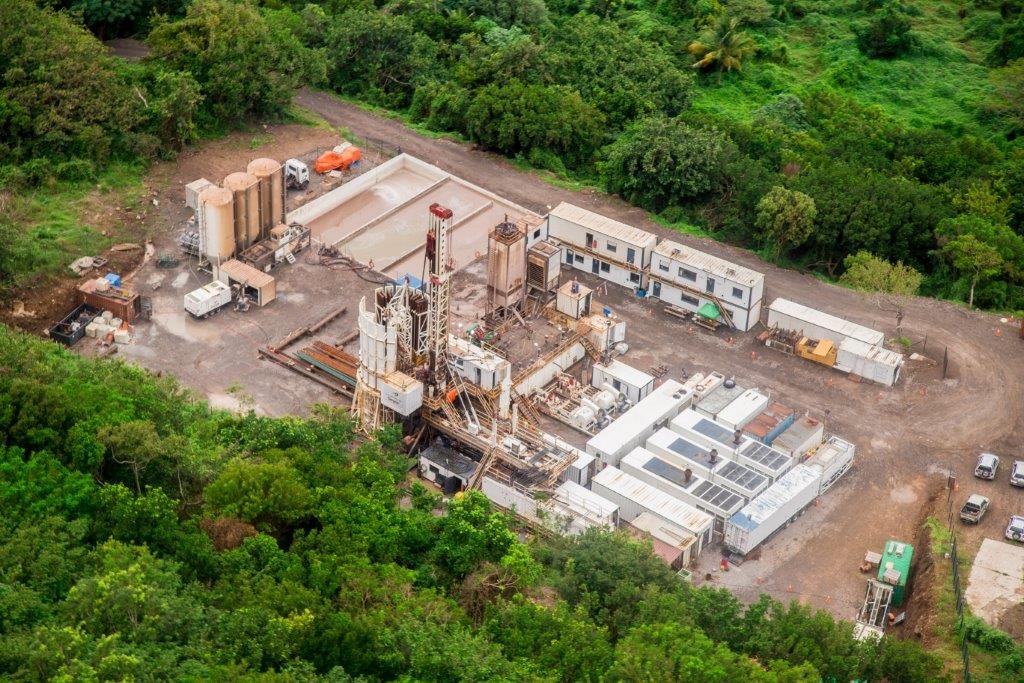
Montserrat’s drilled wells, MON-1 and MON-2, range between 2.3 to 2.8 kilometres deep. “From samples from hot water pond, it looks like you have at least a 180 degrees Celsius,” Ryan said.
But challenges remain. When asked why Montserrat’s initial installed capacity was set at just 3 megawatts, far below the estimated potential, Ryan replied: “That question is probably beyond me… This is still in officially kind of the exploratory phase where it’s like, getting a proof of concept. So the wells are drilled, but unfortunately, the step after that of generation and then coming up with a plan for further development, that stage hasn’t been reached.”
One solution may be directional drilling. “Directional drilling is done all the time. Often you’ll have a well pad, and then you might have five different wells coming off of that single well pad,” he said. “So Mont-3 failed for various reasons. But one option would be there to use the top kilometre of that well and then kick off from it and then directional drill towards a more promising direction.”
The system, however, has its quirks. “The samples are quite tight, as in low permeability,” Ryan explained. “Which indicates that structural permeability associated with faults and stuff like that would be the most important source of permeability.”
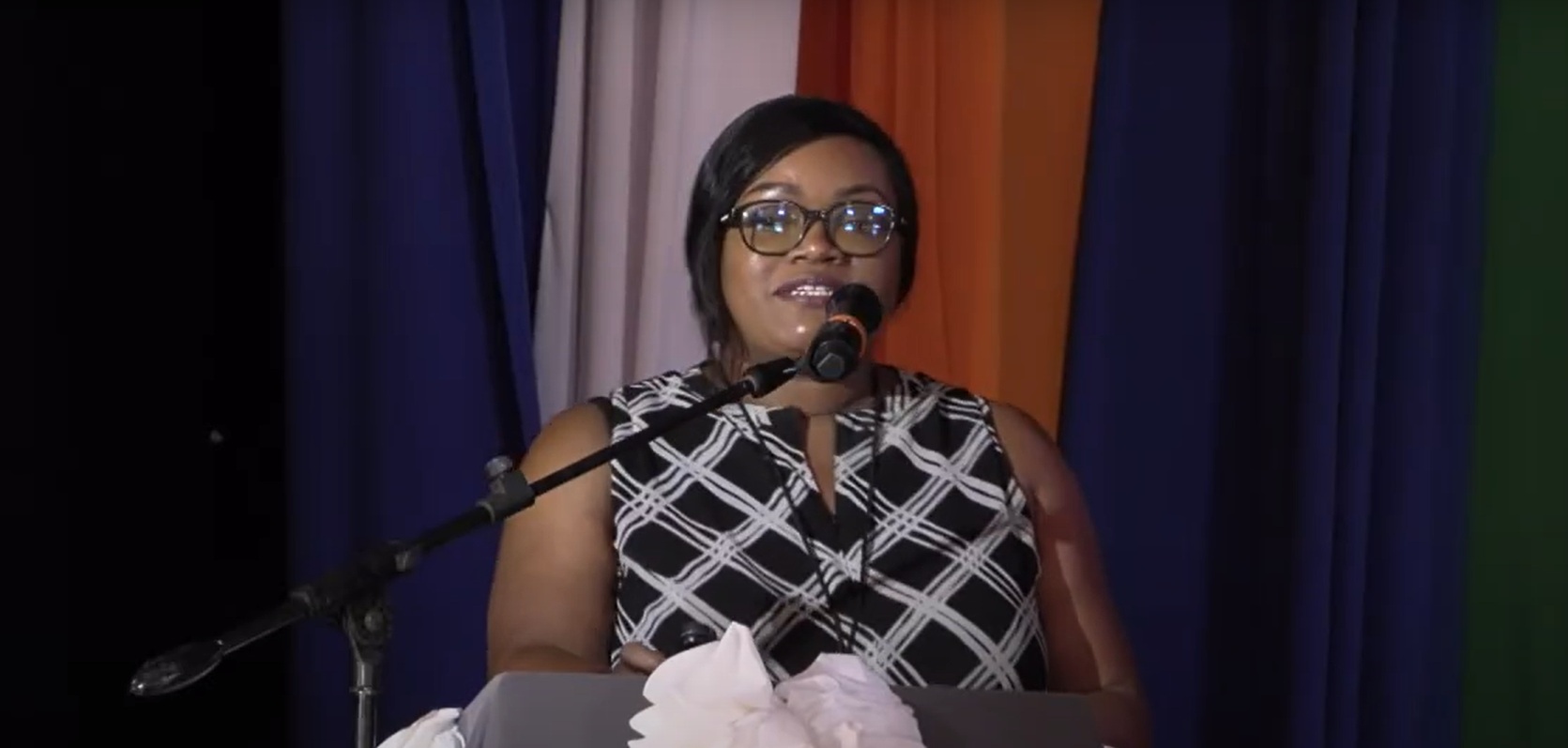
Legal expert Dr. Alicia Elias-Roberts, Dean, Faculty of Law at UWI St. Augustine Campus, said this technical knowledge must be matched with a clear regulatory framework. “We have to appreciate that law is relevant in all the different sectors because you need a legal framework to operate these different sectors,” she said. “You cannot just come out in isolation if you do not appreciate and understand the technical aspects of the actual operation.”
The Geothermal Resources Act classifies the geothermal resource as “sui generis property,” Elias-Roberts noted. “A geothermal resource is not a mineral, nor water resource, nor real property.”
Still, Dr. Ryan is confident in the science. “The fundamentals are promising. The heat is there,” he said. “More geophysical work is needed to better characterise the reservoir… but the science backs it.”
Discover more from Discover Montserrat
Subscribe to get the latest posts sent to your email.