
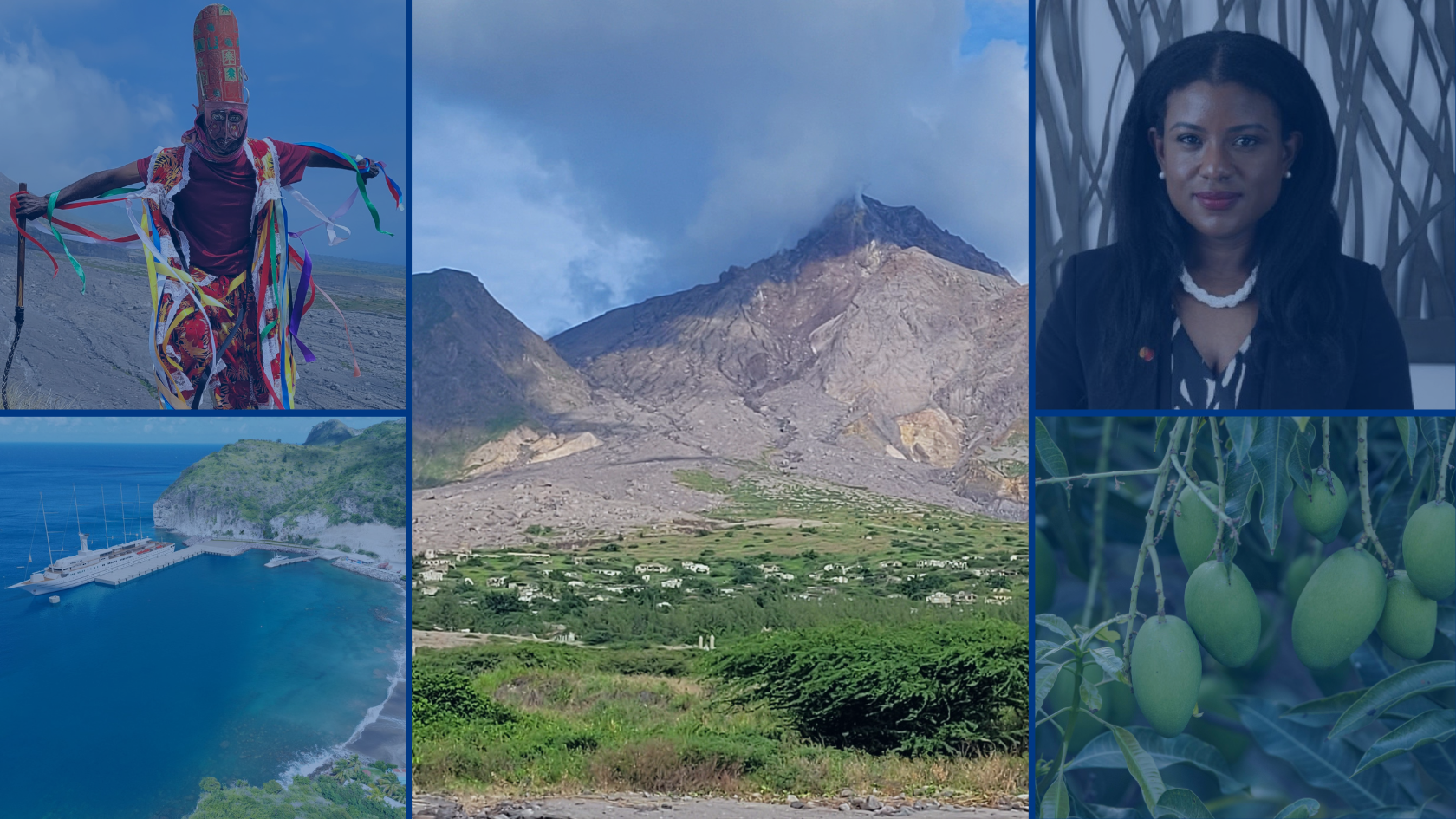
2025 was not a flashy year for Montserrat. It was a revealing one.
It was a year that forced us to confront uncomfortable truths about who we are losing, what we are celebrating, and what kind of future we are actually preparing for. The stories that resonated most were not about spectacle or scale, but about people, their absence, their contribution, their recognition, and their unmet needs.
The Stories That Defined the Year
Among the most-read and most-discussed stories were:
- Eight Montserratians appearing on a US deportation list
- The death of calypsonian “Shorty” Baker in Jamaica after weeks awaiting UK medical evacuation
- Montserrat being named the safest island in the Caribbean by the World Travel Index
- Tributes to Corrin Brooks-Meade and Teacher Edith Duberry
- The appointment of a new General Manager at Bank of Montserrat
- Montserrat’s potential reclassification as a high-income territory and what that could mean
- Monica Meade’s inclusion on the UK Powerlist
- Montserrat being named in the New York Times’ 52 Places to Visit
- The extension of the air service contract with Winair and SVG’s move to purchase a Twin Otter
These stories mattered not just individually, but collectively. They exposed a country grappling simultaneously with migration, access, healthcare, identity, and quality of life.
What remained largely unexplored, however, was the deeper meaning behind the pattern:
what it means when we continue to lose people, while celebrating recognition largely earned elsewhere.
Government Performance: Context Matters
If one were to assign a grade to the United Alliance Government in 2025, B for effort feels fair.
This is a new administration operating in a very different environment from the last time the current premier held office. The island faces a shrinking and ageing population, workforce shortages, institutional fatigue, and infrastructure gaps that have worsened over time. Governing Montserrat today is not the same task it was a decade ago.
That context matters. It does not excuse poor decisions, slow execution, or unclear accountability.
The challenges are well known. The question is whether the response is equal to their scale.
The Port: A Case Study in Decision-Making Failure
The port project is the clearest disappointment of 2025. The groundbreaking was in June 2022 and was expected to be completed in 18 months. Yet, 2026 has come and we don’t have a completed port.
While administrative and operational issues dominated public discussion, the underlying problem is more fundamental. The design approved for the port did not adequately account for the realities of the sea and the site.
The project is already funded, and significant redesign midstream may not be straightforward. However, it is evident that something is not working, whether due to technical constraints, administrative failures, or both. References to “better project management” alone do not explain the delays or the challenges being experienced.
What is required now is honesty and assessment: what exactly is broken, what can realistically be fixed, and what must be adjusted to ensure the port does not become a costly white elephant?
Executing a plan that cannot succeed simply because it has already been approved benefits no one.
Health: Access, Equity, and the Cost of Delay
The confirmation that the new hospital project remains on track is welcome. But 2025 made painfully clear that infrastructure without access, personnel, and systems does not equal healthcare.
The death of calypsonian “Shorty” Baker after weeks awaiting medical evacuation brought into sharp focus what many Montserratians already know: accessing healthcare in the UK is neither straightforward nor guaranteed, whether through the quota system or independently.
Several cases during the year revealed an uncomfortable truth: we are British when it is convenient, and insufficiently British when it matters most.
The work of Donaldson Romeo in bringing this issue to public attention was critical. His advocacy helped expose the gaps in eligibility, timelines, and responsibility when overseas care is required. Awareness, however, must now give way to resolution.
On island, the picture is no less concerning.
A full year without women being able to access mammograms locally, despite equipment being available, is unacceptable. This is not an equipment problem; it is a personnel problem. Delayed diagnoses increase risk, anxiety, and long-term cost.
With an estimated 20 per cent of the population living with diabetes, the question can no longer be limited to medication access. What systems exist for education, nutrition, foot care, early intervention, and lifestyle support? Treating chronic illness only at crisis stage is neither humane nor sustainable.
Montserrat must decide how it will deliver world-class healthcare to residents who are too ill to travel or cannot afford overseas treatment, and what collaborations and systems are needed to prioritise prevention rather than reaction.
Education: The Most Urgent National Failure
If there is one area where 2025 demanded honesty, it was education.
Teacher shortages, particularly at the secondary level, deepened strain across an already fragile system. Minister of Education Dr Ingrid Buffonge repeatedly outlined the scale of the challenge, but the implications go far beyond staffing numbers.
The reality is stark: the current education model is no longer fit for purpose.
Incremental reform will not be enough.
Just as secondary education became universal for Montserratians in the 1980s, the new minimum standard must now be either a university degree or a technical qualification for every student. This is not about privilege or social class. It is about survival in a world that already demands more.
If we are serious about giving our children a real shot at life as it is, and as it is becoming, we must be willing to break the current system completely and rebuild it.
Anything less is a disservice to an entire generation.
Agriculture: Growth to Value Creation
Agriculture remained one of the steadier sectors in 2025, maintaining visibility and practical engagement. But stability alone is not enough.
The opportunity now lies in value-added production.
Every year, mangoes, breadfruit, avocados, and other local staples go to waste. This is not a growing problem; it is a processing and market-access problem.
Mangoes and breadfruit lend themselves to flours, purées, snacks, and frozen products. Avocados can support food products such as salad dressings and shakes for restaurants, as well as skincare and wellness items for day spas and export markets. Even volcanic ash presents opportunities for niche commercial products.
This is where agriculture, tourism, health, and small manufacturing intersect. Turning what we already have into products we can sell must move from idea to execution.
Culture, Festivals and Identity: Opportunity Still Undisciplined
Culture and tourism remain deeply intertwined.
The expansion of masquerade programmes in schools was a genuine success, and credit is due to the Montserrat Arts Council. The increased presence of masquerade groups at Carnival is evidence that year-round cultural investment produces results.
However, performance without context is incomplete. Students and onlookers must understand the history, symbolism, and meaning of the masquerade if the tradition is to be preserved with integrity.
The ongoing uncertainty about whether December’s event is a festival or a carnival continues to show in how the experience is delivered. Festivals are extended marketing opportunities, and the product being sold does not yet reflect Montserrat at its best.
The entry of Delta Petroleum as title sponsor for the Queen of Queens competition was a significant and overdue development. Replicating this success will require sharper products, clearer audiences, and stronger branding.
Tourism: Promotion Without Product Will Continue to Stall
Tourism remains Montserrat’s most difficult conversation.
Despite increased promotional activity in 2025, visitor growth continues to struggle. The reason is simple: marketing cannot compensate for an inconsistent product.
Accommodation standards vary widely. Service reliability remains uneven. Too many experiences depend on individual goodwill rather than professional systems. As a result, promotion raises expectations the on-island experience cannot consistently meet.
Until access, power, service standards, and product quality are stabilised, tourism promotion will continue to underperform.
SHV30 and the Diaspora: Memory, Meaning, and Momentum
One of the most significant moments of 2025 was the commemoration of 30 years since the eruption of Soufrière Hills Volcano.
SHV30 was not simply about remembering a disaster. It was about acknowledging how profoundly that event reshaped Montserrat’s population, economy, governance, and identity. Thirty years on, the eruption remains a dividing line in our history, before and after, and SHV30 provided a necessary space to reflect on what has been lost, what has endured, and what still remains unresolved.
Equally important was who showed up.
Across the year, diaspora-led and diaspora-supported events marked the anniversary through community gatherings, storytelling, outreach, and remembrance. These were not nostalgic exercises. They were acts of reconnection, signals that Montserrat’s story continues to live far beyond its shores.
The government’s first Diaspora Leadership Conference in November added further weight to this moment. It felt, for many, like a reawakening of relationships that had long existed but were not always intentionally nurtured. The engagement was welcomed, overdue, and necessary.
What emerged clearly in 2025 is that the role of the diaspora must be understood more broadly than return migration alone.
While returning home will always matter, impact does not only flow through relocation. Influence, advocacy, investment, visibility, and excellence abroad also resonate back to Montserrat. Recognition such as Monica Meade’s inclusion on the UK Powerlist matters not just personally, but nationally. It demonstrates how Montserratians contribute meaningfully within global systems, and how that contribution can reflect back on the island.
The task ahead is to move beyond episodic engagement.
Diaspora involvement must become:
- Structured rather than symbolic
- Ongoing rather than event-based
- Impact-driven rather than sentimental
SHV30 reminded us that displacement shaped modern Montserrat. 2025 suggested that reconnection may yet help shape its future if approached with intention, clarity, and mutual responsibility.
Looking Ahead to 2026: The UK Relationship and the Question of “Reasonable Needs”
Montserrat remains highly dependent on the United Kingdom for financial support, and 2025 saw closer collaboration with multiple UK departments. That engagement is important and necessary. The UK is not going anywhere, and neither are we.
However, 2025 also exposed a widening gap between what Montserratians understand to be our “reasonable needs” and what is ultimately approved, delivered, or deemed sufficient.
The language often used in relation to Montserrat’s development, reasonable, ambitious, aspirational, deserves closer scrutiny.
In the UK, a hospital would not be considered complete if it housed a mammogram machine or CT scanner without the trained personnel to operate it. A school would not be deemed functional if it lacked the teachers required to deliver basic education to every child. These would not be framed as ambitious expectations; they would be considered non-negotiable standards.
Yet in Montserrat, we are repeatedly asked to accept partial delivery as progress.
This is not simply a funding issue. It is a standards issue.
If the UK is committed to meeting the reasonable needs of Montserratians, then those needs must be defined by outcomes, not installations, by services delivered, not equipment provided.
2025 showed increased willingness to engage and to fix problems, and that matters. But quick fixes and cosmetic solutions, such as temporary access measures or short-term workarounds, cannot substitute for foundational change.
Some attempted solutions during the year, including stopgap access arrangements around Carnival, did not materialise. More importantly, even if they had, they would not have addressed the structural access issues beneath them.
The change Montserrat needs will take time. It will require systems to be properly assessed, reworked, strengthened, or in some cases dismantled and rebuilt. That is slower, harder work, but it is the only path to change that lasts.
Montserrat does not need more temporary patches or lowered expectations. It deserves to build systems that function, endure, and support a quality of life comparable to the standards applied elsewhere under the same flag.
In that context, expectations are not unreasonable. They are overdue.
Discover more from Discover Montserrat
Subscribe to get the latest posts sent to your email.

